It's Sunday, so it must be time for spiders! Here are a few updates from the world of the coolest arthropods there are:
Just in case you thought your size protected you
Snake-eating spiders! A few weeks ago, we had the orb weaver in Cairns eating an unlucky brown tree snake, and now, here's a redback spider from Port Hedland in Western Australia enjoying a similar meal. It's not just in Australia, either! A while ago we had one locally, at Boyce Thompson Arboretum, where a black widow made a slow but gluttonous meal out of an unfortunate coral snake. And those are just the ones we know about. Snakes beware.
Speaking of black widows...
I did a Friday 5 post on the beauties, and why they're my favorite spiders. It's just my own measly blog, but it is my blog, so I can promote my own stuff if I want to. Go check it out if you're so inclined and tell me about your favorite spiders!
I, for one, welcome our new robot spider overlords
Don't worry, it's not really a spider. More like a giant ... robot ... arm ... thing. At an MIT Media Lab, scientists are teaching a robot to weave webs, based on preset structures. One day, they hope to make the process autonomous. I already said I welcome them, right?
Peter Parker's web shooters can't be far away
Scientists , including Jeffery Yarger from my alma mater, Arizona State University, are using high-energy X-rays to study spiders' dragline silk (the webbing they let out to dangle in front of your face). Ultimately, they'd like to produce artificial spider silk that makes use of the same amazing mechanical and elastic properties.
Showing posts with label spider. Show all posts
Showing posts with label spider. Show all posts
Sunday, May 6, 2012


Tuesday, January 17, 2012
Monday Goodies: Tarantulas
Well, darn. Yesterday was a day off from school, which in my brain made it not Monday. So, I wrote up the Monday Goodies really late, uploaded the pictures, and then fell asleep without posting them. My comeback is not off to a great start. Bear with me.
I thought I'd start this week with some spiders. While we're on the topic, are you on Google+ yet? If so, add me! Also, every Sunday I curate a group of really awesome spider photos with two other Google+ friends, Kjetil Greger Pedersen and Chris Mallory. If you like my spider pictures, come check out a bunch more good ones on the Spider Sunday page. And join in next Sunday!
So this week's spider ... That big spider you had in your house was probably not a tarantula, especially not this time of the year.
I say this because, about once a month (last week was the most recent one), someone will send me a photo or tell me a story about a "HUGE spider," ask me what I think it was, and then cut me off to tell me never mind, it was probably a tarantula. Usually, it's a wolf spider, maybe a giant crab spider, or just a house spider and a really scared homeowner who swears "It must have at least been a baby tarantula."
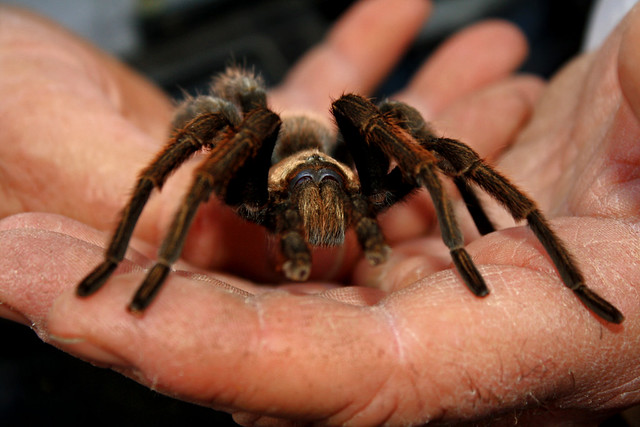
That's not a tarantula. This is a tarantula.
 Once you've seen a few tarantulas, you won't make the mistake again. Adult tarantulas are all-over bulky, not just long-legged. And they're hairy. To use a Dave Barry quote, they're more like “spiders so large they appear to be wearing the pelts of small mammals.”
Of course, Mr. Barry also asserts that menfolk are the spider killers, and women the spider haters. Which of course gets both me and my husband dead wrong. The point is, we know our spiders. (He, so he can run the other way; and me, so I can get closeup photos and be a know-it-all online.)

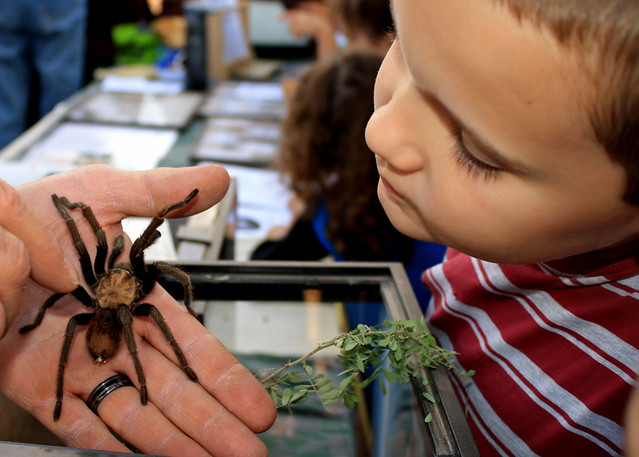
Our local tarantula is the Arizona blond; also called the western desert, Mexican blond, and probably a few names I haven't heard before. They tend to be in 1- to 2-inch burrows anywhere where saguaros and other desert flora abound. As you can see in the photo below, they blend in surprisingly well, until Agh! When did that get here?! The stocky females, which reach sexual maturity around seven to 10 years old, are a uniform brown color. The slightly lankier males, which are the ones most commonly encountered, have copper-colored bodies and black legs.

Also, if you're my son, you think they're absolutely adorable.

More on the Arizona blond tarantula soon, because it's also in my Species a Day, which is getting a big boost as soon as I catch up. As soon as Monday: The Sequel (known to more responsible individuals as Tuesday) gives me a breather. Happy week, everyone.

I thought I'd start this week with some spiders. While we're on the topic, are you on Google+ yet? If so, add me! Also, every Sunday I curate a group of really awesome spider photos with two other Google+ friends, Kjetil Greger Pedersen and Chris Mallory. If you like my spider pictures, come check out a bunch more good ones on the Spider Sunday page. And join in next Sunday!
So this week's spider ... That big spider you had in your house was probably not a tarantula, especially not this time of the year.
I say this because, about once a month (last week was the most recent one), someone will send me a photo or tell me a story about a "HUGE spider," ask me what I think it was, and then cut me off to tell me never mind, it was probably a tarantula. Usually, it's a wolf spider, maybe a giant crab spider, or just a house spider and a really scared homeowner who swears "It must have at least been a baby tarantula."
That's not a tarantula. This is a tarantula.
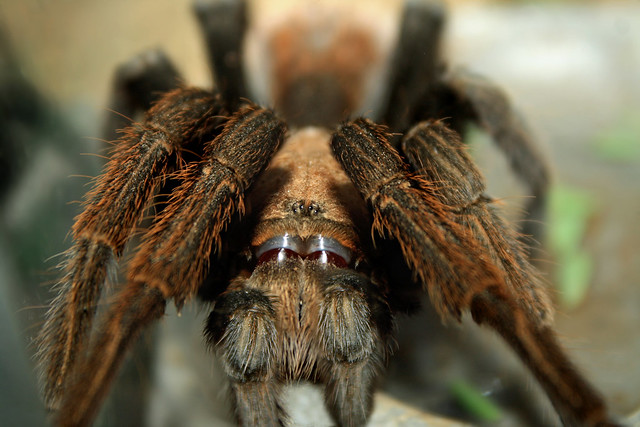 Once you've seen a few tarantulas, you won't make the mistake again. Adult tarantulas are all-over bulky, not just long-legged. And they're hairy. To use a Dave Barry quote, they're more like “spiders so large they appear to be wearing the pelts of small mammals.”
Of course, Mr. Barry also asserts that menfolk are the spider killers, and women the spider haters. Which of course gets both me and my husband dead wrong. The point is, we know our spiders. (He, so he can run the other way; and me, so I can get closeup photos and be a know-it-all online.)
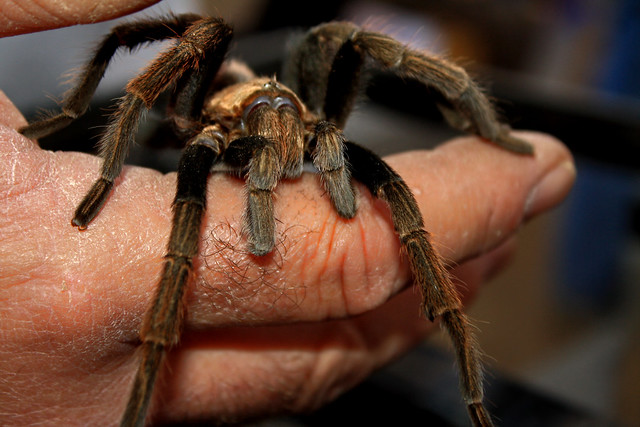
Our local tarantula is the Arizona blond; also called the western desert, Mexican blond, and probably a few names I haven't heard before. They tend to be in 1- to 2-inch burrows anywhere where saguaros and other desert flora abound. As you can see in the photo below, they blend in surprisingly well, until Agh! When did that get here?! The stocky females, which reach sexual maturity around seven to 10 years old, are a uniform brown color. The slightly lankier males, which are the ones most commonly encountered, have copper-colored bodies and black legs.
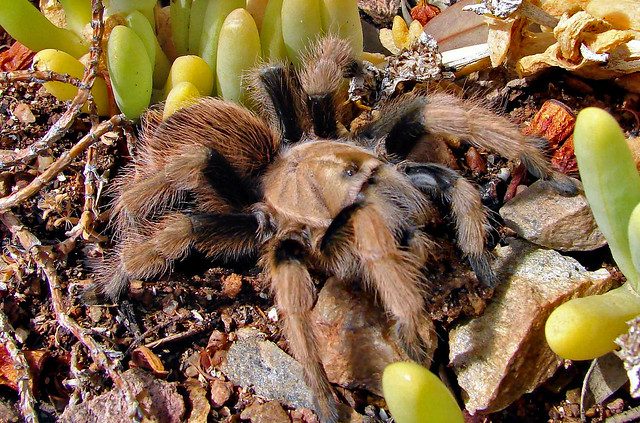
Also, if you're my son, you think they're absolutely adorable.
More on the Arizona blond tarantula soon, because it's also in my Species a Day, which is getting a big boost as soon as I catch up. As soon as Monday: The Sequel (known to more responsible individuals as Tuesday) gives me a breather. Happy week, everyone.
Friday, November 11, 2011
Friday 5: Mealtime
I'm a big, nature-loving softie. Still, predation is pretty cool. It's part of nature, after all. I've mentioned it here and included it in sets like this or this. Here are five more scenes I found gorgeous rather than grisly. (Your mileage, as always, will vary. My husband says if you're not me, you'll probably lean toward grisly. But he thinks I'm weird to eat during medical dramas too.)
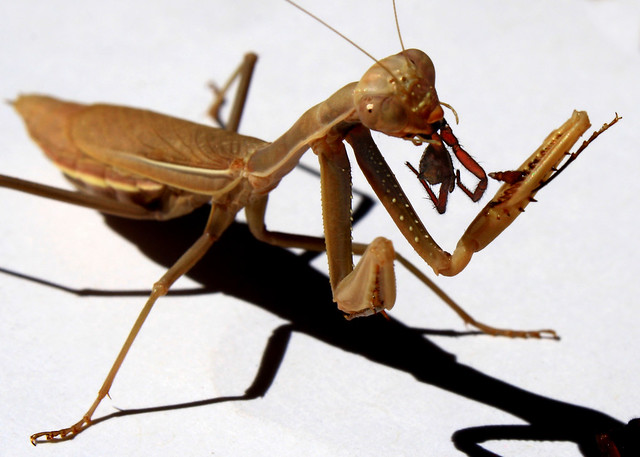
Mantis on spider:


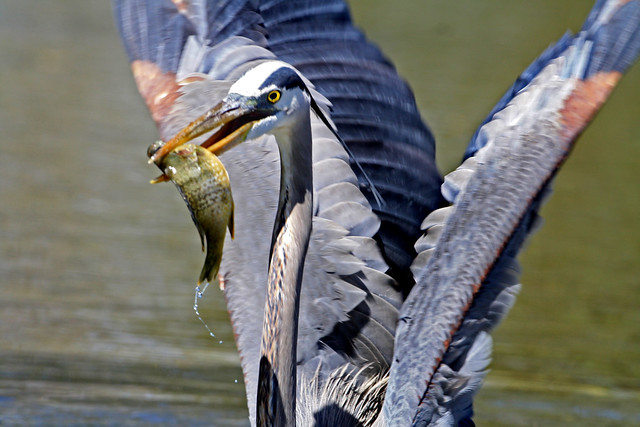
Heron on fish:

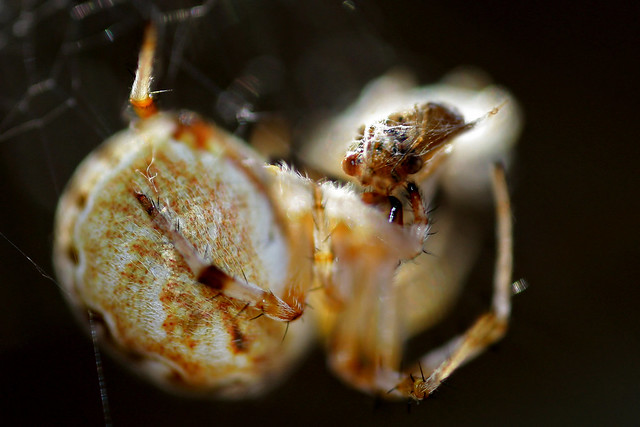
Orb weaver on cicada:

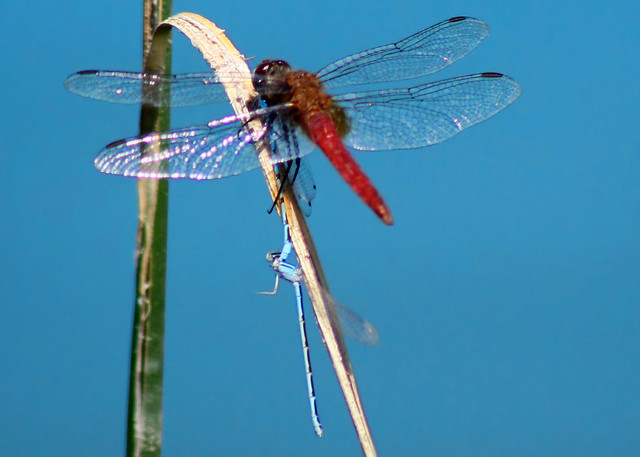
Red-tailed pennant dragonfly on mating damselflies (twin-wrapped snack pack?):

Milkweed bugs on cockroach:

Now then ... Who's hungry?
Mantis on spider:

Heron on fish:
Orb weaver on cicada:
Red-tailed pennant dragonfly on mating damselflies (twin-wrapped snack pack?):
Milkweed bugs on cockroach:

Now then ... Who's hungry?
Monday, October 31, 2011
Monday goodies: Happy Halloween!
I've been on the road all day, and thus away from my main computer files, but it's Monday AND Halloween, so you know I'm totally going to cheat with archive photos post something good anyway!
Five creepy-fun photos, and why I love them
Bark scorpion stinger

The business end. Doesn't it look wicked? The only thing that would make it better would be the scorpion bokeh-ed in the background, but try as I might, I couldn't contort myself to get that shot. I was still disappointed the next day. My husband finds my aspirations rather strange, but there you go.
Black widow

My favorite because, duh, it's a black widow. Also, this one actually elicited a jump from me, for all of you who think I'm a spider-loving freak. (You can totally go on thinking that; I take it as a compliment.) It was almost completely dark outside. I used the flash-focusing light to sort of see where she was. I had to get really close, if I wanted a halfway decent macro. I bobbed in and out, and snapped, and then, she was gone. Well, not gone, really, because she'd only gone out of the field because she was running toward my face. Spiders. They keep you on your toes.
Black widow babies

Because, awww! Babies! No? Come on!
Also, because it makes my husband squirm. I'd just gotten through telling him how I'd checked the whole garage, and there wasn't a single black widow in there now. So in a way, I was right. Not a single black widow.
Black-crowned night heron

Maybe it doesn't look scary to you, but seconds after taking the shot, my ears nearly bled with a KRAWWWAAK, my heart jumped into my throat, and the heron flew away in a satisfied huff. It's the size of a football with a head, but it got me, anyway.
Labyrinth orbweaver

OK, back to actual image critique. I love the black background, the spider entering the frame, the web. I love it all. It's extra cool, too, because this was a total "throwaway" shot. I'm pretty sure I was just messing around with camera settings. This is the most common spider around here, more common maybe even than our black widows. They weave webs in our tree branches, swingset, grill, everywhere. They're not that exciting.
Only, maybe they are. This one looks downright sinister. Perfect for Halloween.
Oooh, also! I'm going to give NaBloPoMo (National Blog Posting Month, for the uninitiated) a try this month. A post every day. I know I have things going on, and that's seriously the reason behind the "Species a Day" pause, but, well, there are always things going on. Expect posts anyway. I'm starting to like this.
Any ideas/requests for the month? Expect many Species, the Monday/Friday regulars, and possibly the posts I promised earlier chronicling my son's clownphobia and the time I forgot to wear pants.
Happy Monday, all. And Happy Halloween!
Five creepy-fun photos, and why I love them
Bark scorpion stinger
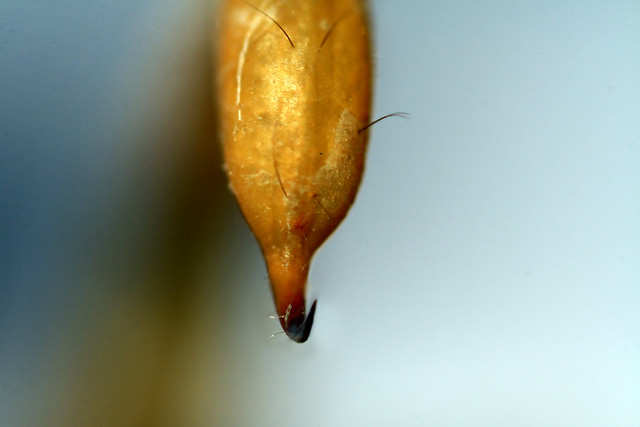
The business end. Doesn't it look wicked? The only thing that would make it better would be the scorpion bokeh-ed in the background, but try as I might, I couldn't contort myself to get that shot. I was still disappointed the next day. My husband finds my aspirations rather strange, but there you go.
Black widow
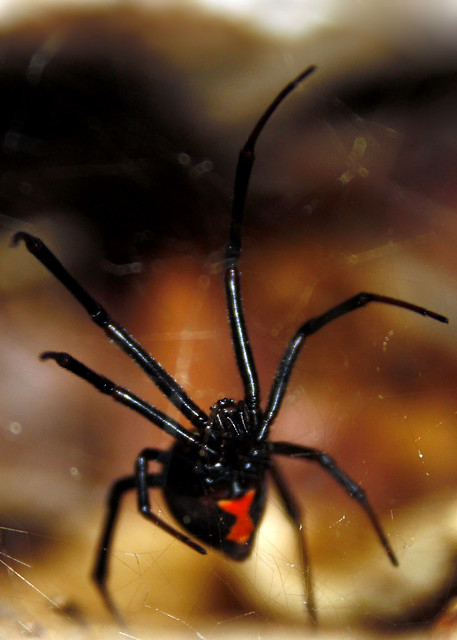
My favorite because, duh, it's a black widow. Also, this one actually elicited a jump from me, for all of you who think I'm a spider-loving freak. (You can totally go on thinking that; I take it as a compliment.) It was almost completely dark outside. I used the flash-focusing light to sort of see where she was. I had to get really close, if I wanted a halfway decent macro. I bobbed in and out, and snapped, and then, she was gone. Well, not gone, really, because she'd only gone out of the field because she was running toward my face. Spiders. They keep you on your toes.
Black widow babies

Because, awww! Babies! No? Come on!
Also, because it makes my husband squirm. I'd just gotten through telling him how I'd checked the whole garage, and there wasn't a single black widow in there now. So in a way, I was right. Not a single black widow.
Black-crowned night heron

Maybe it doesn't look scary to you, but seconds after taking the shot, my ears nearly bled with a KRAWWWAAK, my heart jumped into my throat, and the heron flew away in a satisfied huff. It's the size of a football with a head, but it got me, anyway.
Labyrinth orbweaver
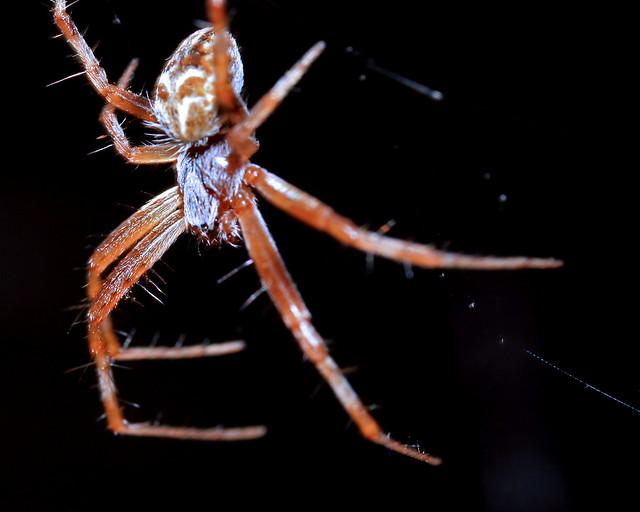
OK, back to actual image critique. I love the black background, the spider entering the frame, the web. I love it all. It's extra cool, too, because this was a total "throwaway" shot. I'm pretty sure I was just messing around with camera settings. This is the most common spider around here, more common maybe even than our black widows. They weave webs in our tree branches, swingset, grill, everywhere. They're not that exciting.
Only, maybe they are. This one looks downright sinister. Perfect for Halloween.
Oooh, also! I'm going to give NaBloPoMo (National Blog Posting Month, for the uninitiated) a try this month. A post every day. I know I have things going on, and that's seriously the reason behind the "Species a Day" pause, but, well, there are always things going on. Expect posts anyway. I'm starting to like this.
Any ideas/requests for the month? Expect many Species, the Monday/Friday regulars, and possibly the posts I promised earlier chronicling my son's clownphobia and the time I forgot to wear pants.
Happy Monday, all. And Happy Halloween!
Monday, August 8, 2011
Species a Day, Week 11
Check out the rest of my Species a Day writeups here.
Oh my gosh, you guys. I'm really behind on this Species a Day thing.
Thanks a lot, summer vacation. With your trips and quality family time and whatnot. Don't you know when I don't have time to write properly, I get all rambly? Seriously, vacation self, I take forever to write a short essay, but give me a time limit, and I turn in William Faulkner or F. Scott Fitzgerald, only without the heavy drinking or the talent. And no one wants to read 4,500 words on scorpion mating habits. It takes more time to write less. So now I get to pay for it, while Summer Break Kim rests up for a brief stint of screwing me over again come winter break.
Some critters. And only some brevity.
Day 71: Least sandpiper, Calidris minutilla
 My peeps. Literally.
Of the smaller North American sandpipers, the five smallest species are so similar; their differences so subtle, headache-causing, and bird-nerd-fight inducing; that they're often just collectively called "peeps." Of these, the smallest is the least sandpiper. I only know them because 1) I have friends who are even bigger bird nerds than I am; 2) they're the ones that make their homes at the Gilbert Riparian Preserve; and 3) only the least, as far as I know, has dark brown upperparts.

We find these sandpipers throughout much of the year at the preserve, one of our go-to bird-spotting spots, though their winter and migratory ranges cover most of Arizona. They're one of the more unassuming shorebirds, timidly picking their way through the shallows, avoiding the larger stilts and avocets. You also can tell them by their shrill - you guessed it - peeping. They seem to enjoy games of chase, pursuing one another over the muddy flats with exaggerated rapid-fire strides and spins that seem to be out of a Charlie Chaplin movie. I keep waiting for the comical stare and piano music.
They're the least peeps, but they're definitely one of our main peeps.
(Yes; these are the puns you can expect after my brain has been fried.)
Day 72: Green darner, Anax junius

Its name translates to "king of June," or as I once read, "lord and master of June." Seriously? How awesome a name is that? I mean, I'm totally in love with all things hexapodal, and I'm not sure I'd have come up with such a cool name. It's certainly much cooler than the appropriation of their common name, darners, as a threat to sew youngsters' mouths shut.
Really, it's a perfect name. In its range -- which is wide indeed -- the acrobatic green darner rules the summer skies.
Although green darners aren't the most common dragonflies around here, they're still one of my favorites. I remember them as one of the first insects I discovered, only these were across the country in New York State's Allegany Park. The huge powerful wings, coupled with the blue and green jewel tones, were captivating. They're the most common and widespread large dragonfly in North America (though I believe the gorgeous and enormous giant darner is larger), and new information about their migration habits is still being uncovered, but it is known that they can migrate more than a thousand miles.

I saw dozens of species of dragonflies in Arizona before I saw green darners again, and when I did, it was like a gem that linked (darned?) my past and present. It's little things like this that make me really love wildlife, and insects in particular -- the closer we look, the more widely we all seem to be linked. Ugh; see what happens when I take a break? Puns, and now sappiness. At least I never made up any weird stories about dragonflies being the "devil's darning needles" to freak out my kid. (However, if you ever DO find an organism capable of sewing his mouth shut from time to time, hook me up.)
Day 73: Loggerhead shrike, Lanius ludovicianus

The loggerhead shrike call is usually a low warbling that crescendos into high-pitched, raspy calls; rather like its presence -- unassuming at first, but potentially fierce. This bird doesn't look much like an adept predator at first glance. It's smallish, with weak feet and no talons. The ferocity is in the acrobatic dives it can make while hunting, and especially in the beak. The loggerhead shrike's hooked beak forms a sort of tooth near the tip that helps the bird rip into its prey -- larger insects and smaller prey like lizards, mice, and other birds -- and can be used to sever the prey's spinal column. After this intense attack, the bird likes to impale its prey on a nearby branch or thorn, the better to tear it apart and wolf it down. This sweet little thing is called the "butcher bird." I think that's pretty awesome.
Day 74: Red-winged blackbird, Agelaius phoeniceus

A passerine bird like the shrike, the red-winged blackbird is a bit more representative of what people picture for the order -- perching, pretty-song-singing birds. You've got the pretty -- those shoulder pads! And you've definitely got the song singing. Still, this bird's not boring. They'll defend their territory against much larger birds -- I saw one chase off a heron once -- and will dive-bomb people on occasion. The territorial displays the males put on are endlessly entertaining, and the songs are actually quite beautiful -- a liquidy, cong-a-lee that repeats over and over again, signaling the beginning of spring and, he hopes, the beginning of a mating liaison. Seriously, even a recording of their song instantly brings marshy grass, cattails, warm light and spring goodness to mind.

The males are the bright ones, naturally, but that just means they're the ones who need to show off, which means it's the females who do all the choosing. The males are jet black except for vivid red shoulders (they're actually called epaulets, which seems even more darling), edged by yellow. The females are streaked brown, with white eyebrows. They're both gorgeous.
Day 75: Mexican amberwing, Perithemis intensa

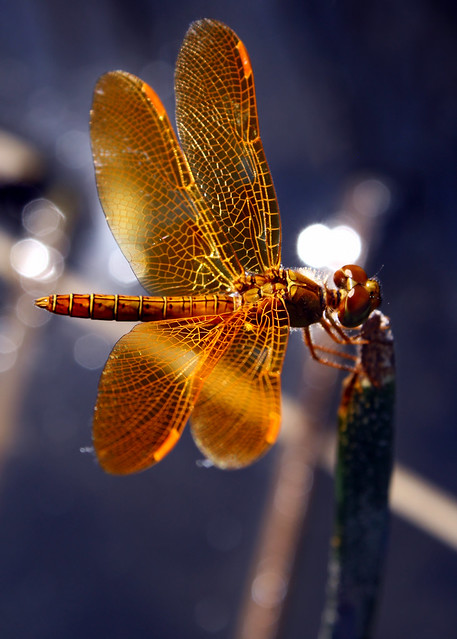
Strictly a Southwestern dragonfly, these little guys prefer shallow, warm water, which makes them a perfect fit for Arizona. They're also feisty and fierce, which I guess also makes them a pretty good fit for Arizona. You'll find Mexican amberwings perched on the grass and reeds near the water at places like the Gilbert Riparian Preserve, Saguaro and Canyon Lakes, the Boyce Thompson Arboretum, and probably a ton of other places that have warm, calm water and accommodating perches. They're entirely a rich amber-orange color, including the wings (hence the name), and the way they light up when the sun hits them is just incredible.

Day 76: Western pondhawk, Erythemis collocata

It was a dragonfly-heavy week. The western pondhawk is fairly widespread throughout the western United States and Mexico, and is a medium-sized dragonfly. The male is a subdued, dark blue color throughout the body, with a bright green face; and the females are green with a black dorsal stripe. The thing I always notice about them is how voracious they are while hunting/eating. More than once I've seen one catch a damselfly (twice while the damselflies were mating -- a twin snack pack, I guess), and once I saw one catch another dragonfly. They'll even eat other western pondhawks.

It was while photographing a western pondhawk that I first met an "Ode." That's what he called himself -- short for a human who's really into odonates, or dragonflies and damselflies. His bible was Common Dragonflies of the Southwest. He let me in on the first semi-proper dragonfly ID -- this blue dragonfly here with the green "nose" was a pondhawk; that one over there with the white nose was a blue dasher. I remember I felt like I had discovered a twofold secret society: that of the dragonflies and that of the Odes, who are so taken with the magic in these four-winged creatures that they will begin preaching their virtues almost immediately upon meeting someone; that is, if the person doesn't first ask why they are forever walking about with four dog-eared field guides, a camera, a set of binoculars, and a dilapidated notepad for new discoveries. I was an easy convert, and many hundreds of dragonfly photos (so many thousands of attempts) later, I'm coming along in my IDs.
Day 77: Jumping spider

OK, so the small amount of expertise I've gained in IDing dragonflies? Totally not there with spider species. This is a brown jumping spider, which is a sucky ID. I'm pretty sure it's different than the one in the header up there (it's definitely smaller), but I'm lost otherwise. Most of the jumpers I see are "brown jumping spiders," which most field guides try to tell me is the widely distributed Platycryptus undatus, though that jumping spider is endemic to Canada and the eastern United States. I'm pegging this one as Platycryptus arizonensis, which is native to Arizona as well as California, New Mexico, and Utah; though it's possible that it's a Platycryptus californicus, which has a wider, more western, and much more north-reaching range. And more of those conclusions were clouded by the fact that these all used to belong to the genus Metacyrba and almost nobody has written anything about Platycryptus. And yeah; I know I could just be making these names up for all you know or care.

You see how this kind of thing can make you nutty? Seriously, though, taxonomy is an awesome thing. Besides the funny names for things (Colon rectum, Agra vation) and nerd fights about what species belongs in which genus (you know what I'm talking about, biologist friends), taxonomy is kind of a beautiful thing. It organizes things. You can tell a lot about an organism from how it's categorized. Platycryptus, for instance, and all jumping spiders, are squat in shape, seemingly built on the horizontal axis -- they can become almost entirely flat, the better to surprise you from between papers or layers of bark -- and only jumping spiders primarily use their eyes for hunting.
Which also means they have keen eyes for catching snoopers and photographers, so I've had precious little time with these awesome tiny creatures. If I accidentally reuse this same species, it's only because I'm too ignorant to know it, and I'm sure at least a few of you will correct me. Which, honestly, is another thing I love about online connections and wildlife obsessions.

More Species soon. What have you all be seeing in your respective necks of the woods lately?
Oh my gosh, you guys. I'm really behind on this Species a Day thing.
Thanks a lot, summer vacation. With your trips and quality family time and whatnot. Don't you know when I don't have time to write properly, I get all rambly? Seriously, vacation self, I take forever to write a short essay, but give me a time limit, and I turn in William Faulkner or F. Scott Fitzgerald, only without the heavy drinking or the talent. And no one wants to read 4,500 words on scorpion mating habits. It takes more time to write less. So now I get to pay for it, while Summer Break Kim rests up for a brief stint of screwing me over again come winter break.
Some critters. And only some brevity.
Day 71: Least sandpiper, Calidris minutilla
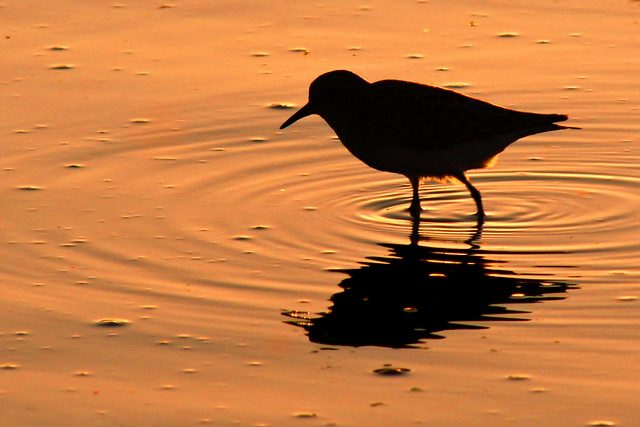 My peeps. Literally.
Of the smaller North American sandpipers, the five smallest species are so similar; their differences so subtle, headache-causing, and bird-nerd-fight inducing; that they're often just collectively called "peeps." Of these, the smallest is the least sandpiper. I only know them because 1) I have friends who are even bigger bird nerds than I am; 2) they're the ones that make their homes at the Gilbert Riparian Preserve; and 3) only the least, as far as I know, has dark brown upperparts.

We find these sandpipers throughout much of the year at the preserve, one of our go-to bird-spotting spots, though their winter and migratory ranges cover most of Arizona. They're one of the more unassuming shorebirds, timidly picking their way through the shallows, avoiding the larger stilts and avocets. You also can tell them by their shrill - you guessed it - peeping. They seem to enjoy games of chase, pursuing one another over the muddy flats with exaggerated rapid-fire strides and spins that seem to be out of a Charlie Chaplin movie. I keep waiting for the comical stare and piano music.
They're the least peeps, but they're definitely one of our main peeps.
(Yes; these are the puns you can expect after my brain has been fried.)
Day 72: Green darner, Anax junius
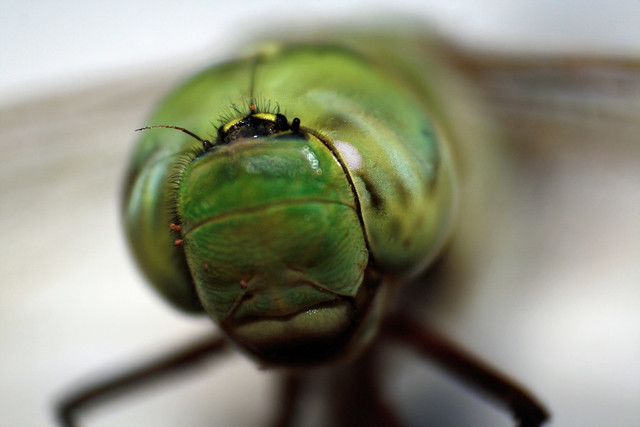
Its name translates to "king of June," or as I once read, "lord and master of June." Seriously? How awesome a name is that? I mean, I'm totally in love with all things hexapodal, and I'm not sure I'd have come up with such a cool name. It's certainly much cooler than the appropriation of their common name, darners, as a threat to sew youngsters' mouths shut.
Really, it's a perfect name. In its range -- which is wide indeed -- the acrobatic green darner rules the summer skies.
Although green darners aren't the most common dragonflies around here, they're still one of my favorites. I remember them as one of the first insects I discovered, only these were across the country in New York State's Allegany Park. The huge powerful wings, coupled with the blue and green jewel tones, were captivating. They're the most common and widespread large dragonfly in North America (though I believe the gorgeous and enormous giant darner is larger), and new information about their migration habits is still being uncovered, but it is known that they can migrate more than a thousand miles.

I saw dozens of species of dragonflies in Arizona before I saw green darners again, and when I did, it was like a gem that linked (darned?) my past and present. It's little things like this that make me really love wildlife, and insects in particular -- the closer we look, the more widely we all seem to be linked. Ugh; see what happens when I take a break? Puns, and now sappiness. At least I never made up any weird stories about dragonflies being the "devil's darning needles" to freak out my kid. (However, if you ever DO find an organism capable of sewing his mouth shut from time to time, hook me up.)
Day 73: Loggerhead shrike, Lanius ludovicianus
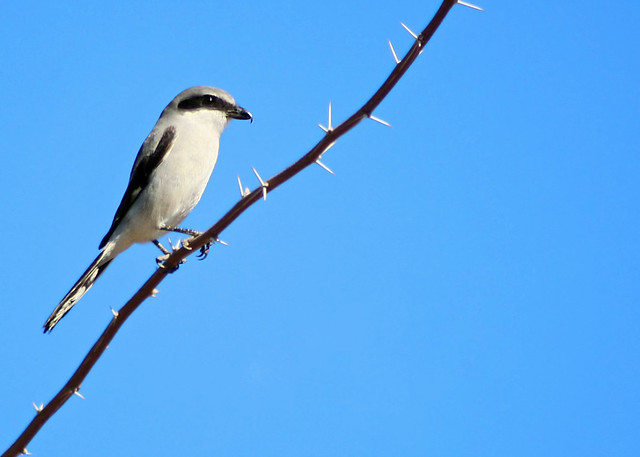
The loggerhead shrike call is usually a low warbling that crescendos into high-pitched, raspy calls; rather like its presence -- unassuming at first, but potentially fierce. This bird doesn't look much like an adept predator at first glance. It's smallish, with weak feet and no talons. The ferocity is in the acrobatic dives it can make while hunting, and especially in the beak. The loggerhead shrike's hooked beak forms a sort of tooth near the tip that helps the bird rip into its prey -- larger insects and smaller prey like lizards, mice, and other birds -- and can be used to sever the prey's spinal column. After this intense attack, the bird likes to impale its prey on a nearby branch or thorn, the better to tear it apart and wolf it down. This sweet little thing is called the "butcher bird." I think that's pretty awesome.
Day 74: Red-winged blackbird, Agelaius phoeniceus
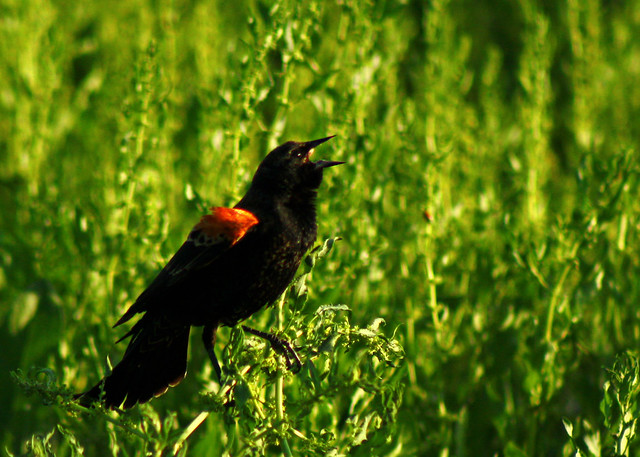
A passerine bird like the shrike, the red-winged blackbird is a bit more representative of what people picture for the order -- perching, pretty-song-singing birds. You've got the pretty -- those shoulder pads! And you've definitely got the song singing. Still, this bird's not boring. They'll defend their territory against much larger birds -- I saw one chase off a heron once -- and will dive-bomb people on occasion. The territorial displays the males put on are endlessly entertaining, and the songs are actually quite beautiful -- a liquidy, cong-a-lee that repeats over and over again, signaling the beginning of spring and, he hopes, the beginning of a mating liaison. Seriously, even a recording of their song instantly brings marshy grass, cattails, warm light and spring goodness to mind.
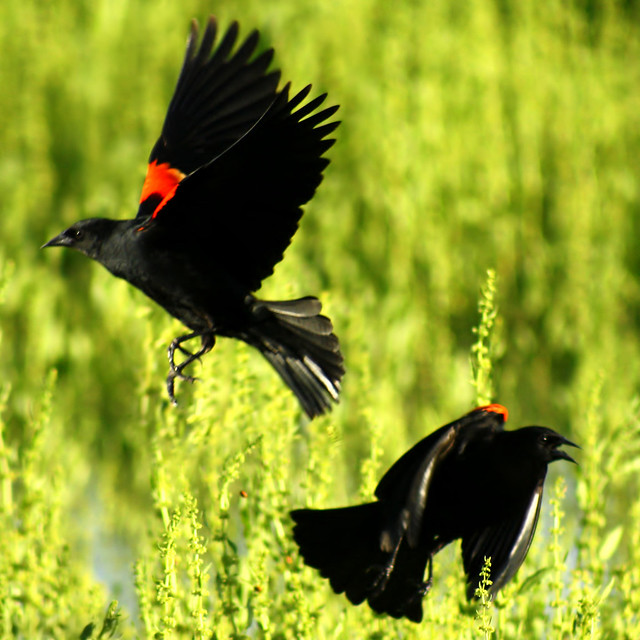
The males are the bright ones, naturally, but that just means they're the ones who need to show off, which means it's the females who do all the choosing. The males are jet black except for vivid red shoulders (they're actually called epaulets, which seems even more darling), edged by yellow. The females are streaked brown, with white eyebrows. They're both gorgeous.
Day 75: Mexican amberwing, Perithemis intensa
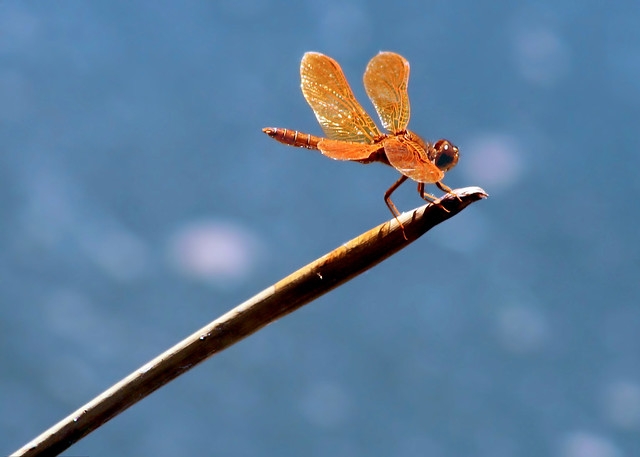
Strictly a Southwestern dragonfly, these little guys prefer shallow, warm water, which makes them a perfect fit for Arizona. They're also feisty and fierce, which I guess also makes them a pretty good fit for Arizona. You'll find Mexican amberwings perched on the grass and reeds near the water at places like the Gilbert Riparian Preserve, Saguaro and Canyon Lakes, the Boyce Thompson Arboretum, and probably a ton of other places that have warm, calm water and accommodating perches. They're entirely a rich amber-orange color, including the wings (hence the name), and the way they light up when the sun hits them is just incredible.
Day 76: Western pondhawk, Erythemis collocata

It was a dragonfly-heavy week. The western pondhawk is fairly widespread throughout the western United States and Mexico, and is a medium-sized dragonfly. The male is a subdued, dark blue color throughout the body, with a bright green face; and the females are green with a black dorsal stripe. The thing I always notice about them is how voracious they are while hunting/eating. More than once I've seen one catch a damselfly (twice while the damselflies were mating -- a twin snack pack, I guess), and once I saw one catch another dragonfly. They'll even eat other western pondhawks.

It was while photographing a western pondhawk that I first met an "Ode." That's what he called himself -- short for a human who's really into odonates, or dragonflies and damselflies. His bible was Common Dragonflies of the Southwest. He let me in on the first semi-proper dragonfly ID -- this blue dragonfly here with the green "nose" was a pondhawk; that one over there with the white nose was a blue dasher. I remember I felt like I had discovered a twofold secret society: that of the dragonflies and that of the Odes, who are so taken with the magic in these four-winged creatures that they will begin preaching their virtues almost immediately upon meeting someone; that is, if the person doesn't first ask why they are forever walking about with four dog-eared field guides, a camera, a set of binoculars, and a dilapidated notepad for new discoveries. I was an easy convert, and many hundreds of dragonfly photos (so many thousands of attempts) later, I'm coming along in my IDs.
Day 77: Jumping spider
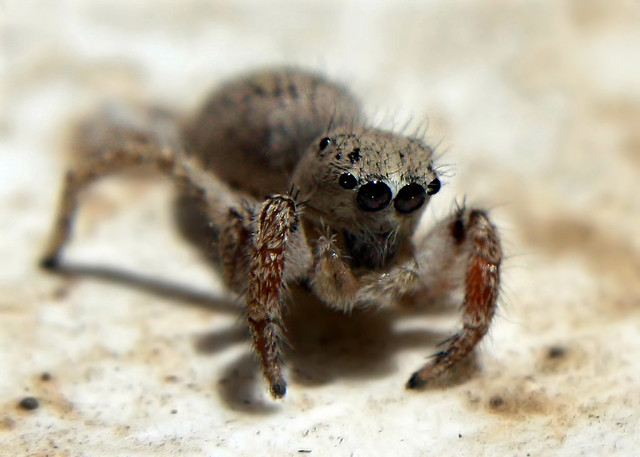
OK, so the small amount of expertise I've gained in IDing dragonflies? Totally not there with spider species. This is a brown jumping spider, which is a sucky ID. I'm pretty sure it's different than the one in the header up there (it's definitely smaller), but I'm lost otherwise. Most of the jumpers I see are "brown jumping spiders," which most field guides try to tell me is the widely distributed Platycryptus undatus, though that jumping spider is endemic to Canada and the eastern United States. I'm pegging this one as Platycryptus arizonensis, which is native to Arizona as well as California, New Mexico, and Utah; though it's possible that it's a Platycryptus californicus, which has a wider, more western, and much more north-reaching range. And more of those conclusions were clouded by the fact that these all used to belong to the genus Metacyrba and almost nobody has written anything about Platycryptus. And yeah; I know I could just be making these names up for all you know or care.
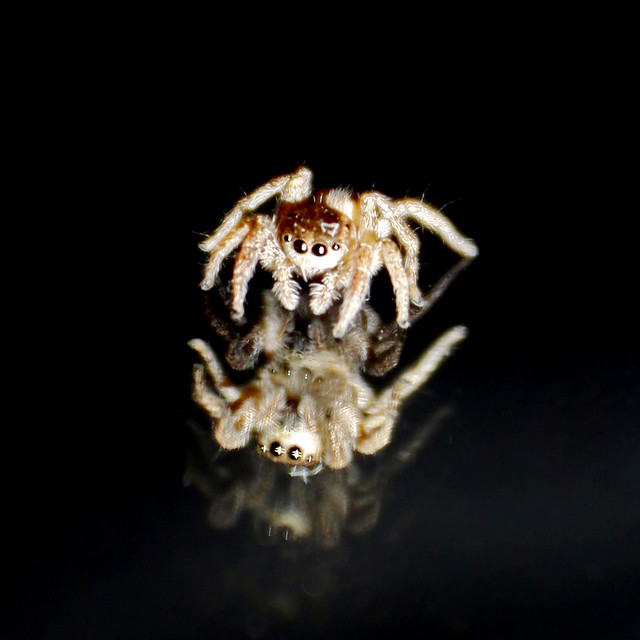
You see how this kind of thing can make you nutty? Seriously, though, taxonomy is an awesome thing. Besides the funny names for things (Colon rectum, Agra vation) and nerd fights about what species belongs in which genus (you know what I'm talking about, biologist friends), taxonomy is kind of a beautiful thing. It organizes things. You can tell a lot about an organism from how it's categorized. Platycryptus, for instance, and all jumping spiders, are squat in shape, seemingly built on the horizontal axis -- they can become almost entirely flat, the better to surprise you from between papers or layers of bark -- and only jumping spiders primarily use their eyes for hunting.
Which also means they have keen eyes for catching snoopers and photographers, so I've had precious little time with these awesome tiny creatures. If I accidentally reuse this same species, it's only because I'm too ignorant to know it, and I'm sure at least a few of you will correct me. Which, honestly, is another thing I love about online connections and wildlife obsessions.

More Species soon. What have you all be seeing in your respective necks of the woods lately?
Friday, April 1, 2011
Species a Day, Week 4
Previous weeks:
Week 1
Week 2
Week 3
No snappy intro. Just animals. I'm double-posting after a brief break in posting, though, so catch my attempt at photography tips right before this.
Day 22: Broad-billed hummingbird
Broad-billed hummingbirds, Cynanthus latirostris, are common summer residents in Arizona's riparian areas, and breed in parts of our state. They are readily seen at Boyce Thompson Arboretum, though not as readily photographed, as least successfully. The males are seriously, flamboyantly gorgeous. Metallic blue and green plumage, deep blue throat feathers, bright red bill. The females are duller in color -- poor female hummingbirds. They never get the spotlight.

Day 23: Giant crab spider
The broad-billed started the week on a high note, but this one turned out to be my favorite, if only because of the story. I was
 avoiding work checking my e-mail, and noticed a message from my mom entitled "Spider question." She had "found a GIANT SPIDER" in her shed, and had questions.
Now, most people's questions would involve "Is it poisonous?" and "How do I get rid of it?" But it's my mom, and you probably figure I must get it from somewhere, so you should be unsurprised that: 1) she knows the difference between "venomous" and "poisonous" and would never ask such a ridiculous question (the reference material she sent me had "poisonous" incredulously highlighted); and 2) she didn't want to get rid of it. She made a habitat for it, complete with desert rocks and twigs, a tiny cap of water, and a supply of crickets and grasshoppers.
That weekend, I came over with my camera to photograph the beauty, which we'd by now tentatively identified as a giant crab spider, Olios giganteus. I knelt beside the spider. I scooted beneath her. My mom lifted the container up to the light. We discussed whether the dining room light was hitting the chelicerae sufficiently. The rest of my family looked at us as though we were crazy.
I took her home, intending to get some even better shots in my "spider studio" I've set up (which may or may not involve a pair of my husband's pants as a backdrop; shhh). I released her. Then, I lost the pictures. Figuring it was a lost cause, I went back to the field to check for her, and found her again, clinging to a rock. She allowed me to scoop her back into her "home." However, I still don't have pictures, because she went into hiding. Don't worry; I haven't lost her. She's now woven a cocoon around herself, which could mean she's going to lay eggs. I'm very happy about this.

In the meantime, Lynette from BugGuide.Net contacted me to ask me to contribute the above photo to their site, and also filled me in on the cloudy taxonomy of Olios spiders. Apparently, we have nine species of the genus in the United States, and according to this site, we have five of them in Arizona. She also passed on that the genus hasn't really ever been thoroughly studied since the species writeups 75 years ago. Taxonomy can be a contentious and confusing field, so I'll leave it at genus for now. Still. More adventures in spider raising. Hooray! (Thanks, Mom.)
Day 24: House sparrow
The house sparrow (Passer domesticus) is not originally an Arizonan, but it's been here for a while. It can be destructive. It's boring. It's considered a "junk bird" by birders and photographers.
And sometimes, it's pretty gorgeous.

Day 25: Long-billed dowitcher
They're one of the "other birds" wading in the ponds at places like the Gilbert Riparian Preserve. Long-billed dowitchers (we don't usually have the short-billed kind), Limnodromus scolopaceus, wade through the shallows and pluck small creatures up like little avian sewing machines. I usually overlook them in favor of the herons, egrets, and stilts. Maybe I'll make an effort to capture more of them.

Day 26: Dainty sulphur
The dainty sulphur (Nathalis iole) is the smallest butterfly in its family, and these guys are hard to capture. They flit from one flower to the next, and nearly all my shots are of an empty flower. But they really are gorgeous when you stop to look at them. The males flutter inches above the ground in search of females, and if the lady seems reluctant, they prominently display their dorsal bars and their androconial spots. Ooh, baby.

Day 27: Inca dove
Smaller than mourning and white-winged doves, Inca doves (Scardafella inca, though the genus has been debated) are also a little more timid. You can tell them by the scaled pattern on their wings and bodies -- my son says they look like pine cones. I almost never see one alone. They're always in pairs or groups. Incas range through the Southwest into Mexico and Central America, and don't live anywhere that the Inca empire ever occupied. Go figure.

Day 28: Black Saddlebags
This is what I love about the Internet. I had missed a detail on my own photo and couldn't ID this dragonfly. Because I'm contacts with so many expert IDers, I posted it, and within a day, I had it. Credit goes to Jeff (vai_boy) from Flickr for the ID. It is, of course, a black saddlebags (you can see the "saddlebags" on the wings below its body, though they don't show up really well in this shot).
Black saddlebags, or Tramea lacerata, are skimmer dragonflies found throughout the continent, especially near ponds or bodies of still water. They especially like to eat mosquito larvae, so these are good guys to have around.
They also have an interesting reproductive adaptation. Because the female only mates once, storing the sperm for fertilization, another male who mates with her will remove the previous sperm with a special sperm-removal brush. See? And you thought you wouldn't learn anything new here.

More next week. I've already got four birds, so I'll try and mix it up with an insect or mammal. Or spider, of course.
Week 1
Week 2
Week 3
No snappy intro. Just animals. I'm double-posting after a brief break in posting, though, so catch my attempt at photography tips right before this.
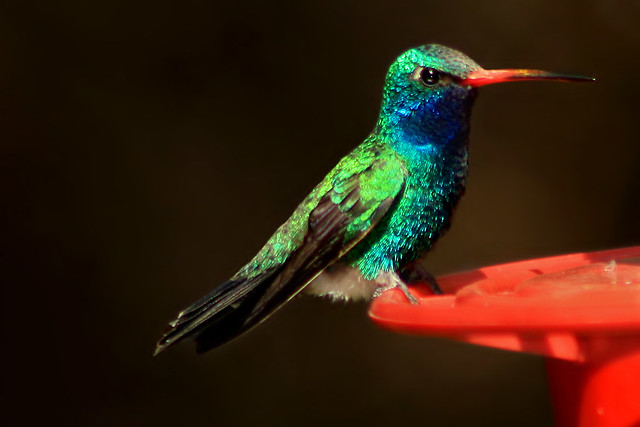
Day 22: Broad-billed hummingbird
Broad-billed hummingbirds, Cynanthus latirostris, are common summer residents in Arizona's riparian areas, and breed in parts of our state. They are readily seen at Boyce Thompson Arboretum, though not as readily photographed, as least successfully. The males are seriously, flamboyantly gorgeous. Metallic blue and green plumage, deep blue throat feathers, bright red bill. The females are duller in color -- poor female hummingbirds. They never get the spotlight.
Day 23: Giant crab spider
The broad-billed started the week on a high note, but this one turned out to be my
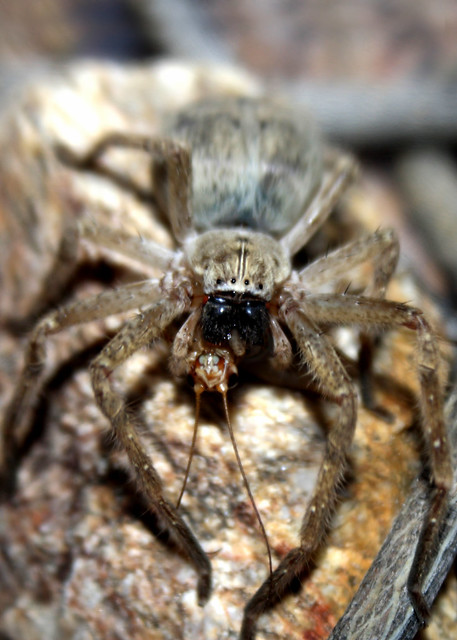 favorite, if only because of the story. I was
 Now, most people's questions would involve "Is it poisonous?" and "How do I get rid of it?" But it's my mom, and you probably figure I must get it from somewhere, so you should be unsurprised that: 1) she knows the difference between "venomous" and "poisonous" and would never ask such a ridiculous question (the reference material she sent me had "poisonous" incredulously highlighted); and 2) she didn't want to get rid of it. She made a habitat for it, complete with desert rocks and twigs, a tiny cap of water, and a supply of crickets and grasshoppers.
That weekend, I came over with my camera to photograph the beauty, which we'd by now tentatively identified as a giant crab spider, Olios giganteus. I knelt beside the spider. I scooted beneath her. My mom lifted the container up to the light. We discussed whether the dining room light was hitting the chelicerae sufficiently. The rest of my family looked at us as though we were crazy.
I took her home, intending to get some even better shots in my "spider studio" I've set up (which may or may not involve a pair of my husband's pants as a backdrop; shhh). I released her. Then, I lost the pictures. Figuring it was a lost cause, I went back to the field to check for her, and found her again, clinging to a rock. She allowed me to scoop her back into her "home." However, I still don't have pictures, because she went into hiding. Don't worry; I haven't lost her. She's now woven a cocoon around herself, which could mean she's going to lay eggs. I'm very happy about this.
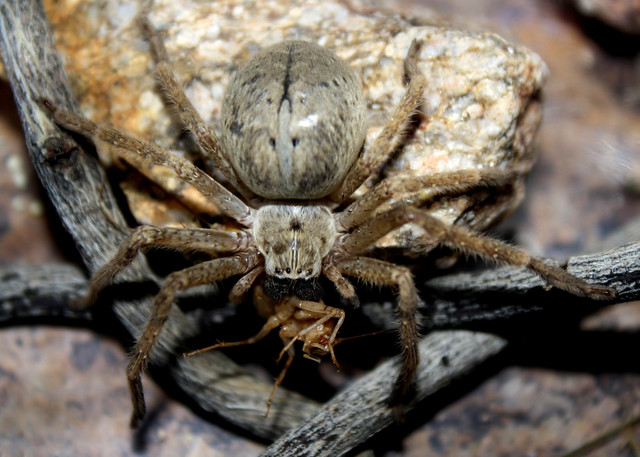
In the meantime, Lynette from BugGuide.Net contacted me to ask me to contribute the above photo to their site, and also filled me in on the cloudy taxonomy of Olios spiders. Apparently, we have nine species of the genus in the United States, and according to this site, we have five of them in Arizona. She also passed on that the genus hasn't really ever been thoroughly studied since the species writeups 75 years ago. Taxonomy can be a contentious and confusing field, so I'll leave it at genus for now. Still. More adventures in spider raising. Hooray! (Thanks, Mom.)
Day 24: House sparrow
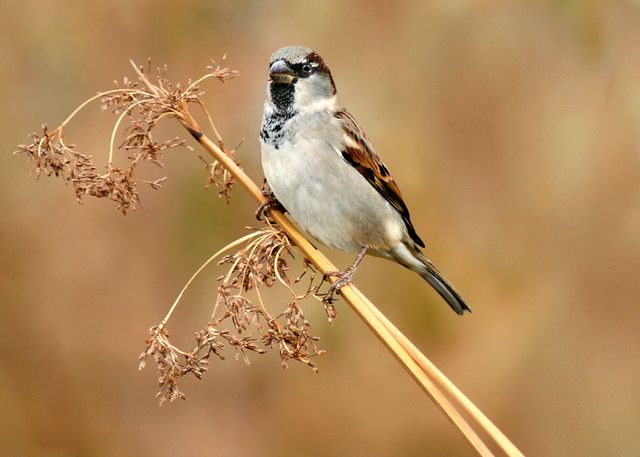
The house sparrow (Passer domesticus) is not originally an Arizonan, but it's been here for a while. It can be destructive. It's boring. It's considered a "junk bird" by birders and photographers.
And sometimes, it's pretty gorgeous.
Day 25: Long-billed dowitcher
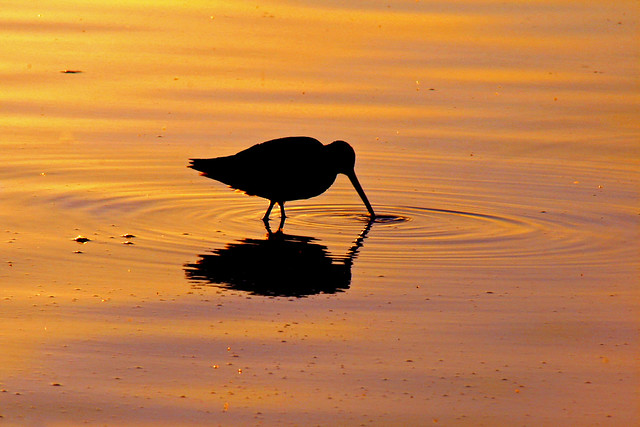
They're one of the "other birds" wading in the ponds at places like the Gilbert Riparian Preserve. Long-billed dowitchers (we don't usually have the short-billed kind), Limnodromus scolopaceus, wade through the shallows and pluck small creatures up like little avian sewing machines. I usually overlook them in favor of the herons, egrets, and stilts. Maybe I'll make an effort to capture more of them.
Day 26: Dainty sulphur
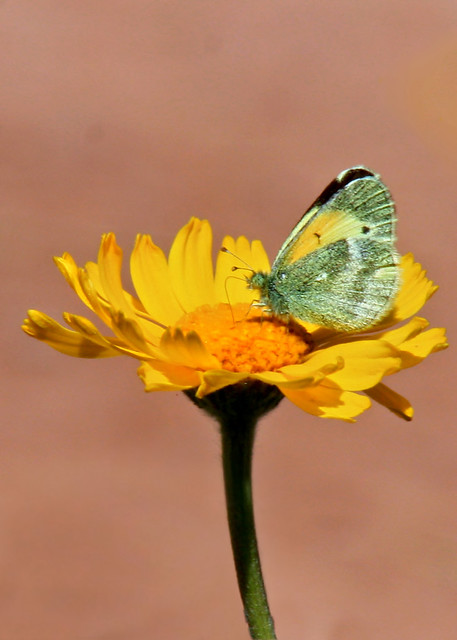
The dainty sulphur (Nathalis iole) is the smallest butterfly in its family, and these guys are hard to capture. They flit from one flower to the next, and nearly all my shots are of an empty flower. But they really are gorgeous when you stop to look at them. The males flutter inches above the ground in search of females, and if the lady seems reluctant, they prominently display their dorsal bars and their androconial spots. Ooh, baby.
Day 27: Inca dove
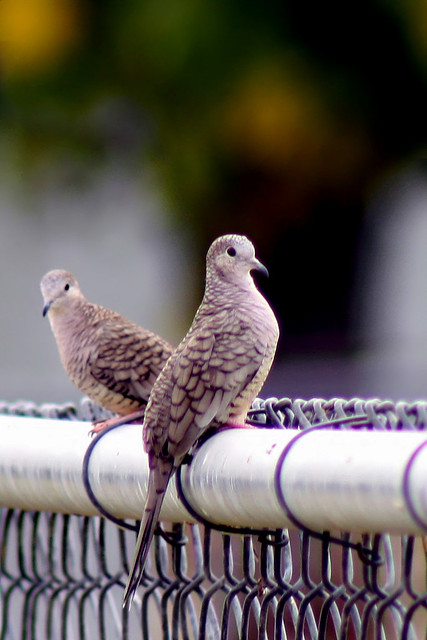
Smaller than mourning and white-winged doves, Inca doves (Scardafella inca, though the genus has been debated) are also a little more timid. You can tell them by the scaled pattern on their wings and bodies -- my son says they look like pine cones. I almost never see one alone. They're always in pairs or groups. Incas range through the Southwest into Mexico and Central America, and don't live anywhere that the Inca empire ever occupied. Go figure.
Day 28: Black Saddlebags
This is what I love about the Internet. I had missed a detail on my own photo and couldn't ID this dragonfly. Because I'm contacts with so many expert IDers, I posted it, and within a day, I had it. Credit goes to Jeff (vai_boy) from Flickr for the ID. It is, of course, a black saddlebags (you can see the "saddlebags" on the wings below its body, though they don't show up really well in this shot).
Black saddlebags, or Tramea lacerata, are skimmer dragonflies found throughout the continent, especially near ponds or bodies of still water. They especially like to eat mosquito larvae, so these are good guys to have around.
They also have an interesting reproductive adaptation. Because the female only mates once, storing the sperm for fertilization, another male who mates with her will remove the previous sperm with a special sperm-removal brush. See? And you thought you wouldn't learn anything new here.

More next week. I've already got four birds, so I'll try and mix it up with an insect or mammal. Or spider, of course.
Tuesday, March 15, 2011
Species a Day, Week 2
The second week in my Species a Day project. Check out Week 1 here.
Also, if anyone ever thinks I'm getting an ID wrong on these critters, by all means, let me know. I think I'm pretty good, but I slip up, and this is one of the few instances in which I'll gladly solicit criticism. I know half of these offhand, and the rest I can usually identify, but wild animals have an annoying habit of refusing to pose beside a field guide or my Google search results.
Day 8: Double-crested cormorant

Double-crested cormorants, Phalacrocorax auritus, in non-breeding plumage. Voracious gulpers of fish and chasers of one another. Distinctive face. How has no one made a cartoon character out of one of these guys?
Seen at water holes all around, but we especially like the ones at the Gilbert Riparian Preserve (they also have neotropic cormorants, but word has it that double-cresteds are more common, and that, along with the bill and tail lengths, cinched it for me, I think). These guys have personality -- cormorality? Whatever. They're hilarious. Instead of chirping or squawking, they have a kind of burping noise that they make at one another. And they make it all the time. If you go toward the back of the preserve on most evenings, you can hear them preparing to roost in some of the large trees; dozens and dozens of them, into the hundreds, maybe. Each time a new cormorant comes to the tree, it steals an already-occupied branch, sending the occupant careening to grab another branch, often another occupied one, and so on. There are usually free branches, but they rarely go for those. They steal and bicker, in an enormous chorus of irritated belches.

They act kind of the same when they're fishing, or even just standing around. I really kind of dig the perpetually glaring turquoise gaze and that grimace of a bill. (My son and husband theorize it's because I see myself in the derisive glare and constant scolding. To which I say ... Hey! Get off my seat!)
Day 9: Great egret

Ardea alba, also known as the Great White Egret, or bird way to gorgeous to make droppings the size of my entire body.
Love these guys. I miss about 95 percent of the shots I attempt, especially when they're flying, mostly because they're more fun to watch. Their expansive white wings and back carve a graceful arch through the air. Their long necks form tucked in S shapes as the sharp bills cut the air. Even their feet -- a little gnarled and scaly close up -- trail pin-straight behind them in a graceful black tail. When they brake to land, the feet pull up and the wings spread, and light bleeds through each overlapping feather, stark-white alternating with gray elliptical accents, like a series of ethereal Venn diagrams.

(It can't all be nature rhapsodizing. I'm still a dork.)
Day 10: Wolf spider (I think)
I'm the spider gal, but I'm not an expert at identifying them all. After all, my favorite spiders are some of the most readily identifiable, and I still run into quandaries.

This one was tough for me, but the eye orientation, legs, and general body structure and size on this one have me thinking it's a wolf spider in the Rabidosa genus. That means "rabid" wolf spider, by the way, and I think it's an apt name for really any wolf spider. I'm not scared of them, mind you. (I know. I'm nuts.) But that doesn't mean, if I have the lens nearly touching the thing and it decides to run for me at Mach 10, that I'm not going to jump back a few feet.
These live in our garage sometimes. Don't tell my husband.
Day 11: House finch

A male house finch, Carpodacus mexicanus, in a paloverde. I really should photograph these guys more often.

Common. But also gorgeous. House finches started as residents of Mexico and the Southwestern United States, but have been introduced and sold (illegally) throughout the rest of the country over the years. In most cases, they've settled readily, foraging for seeds and grains wherever they happen to be. Whether you lament the species they might have displaced or are happy to see the little guys, you've got to admit, as one online friend put it when I posted the picture: "Everywhere we go, from forest to desert, New England to Arizona, house finches are there. Nesting in eaves, nesting in chollas, nearly always singing ... this bird's got game!"
Day 12: Small milkweed bug
A small milkweed bug, Lygaeus kalmii, on my fingertip. I remember these as some of the first splashes of color I saw in the insects that shared our backyard growing up. I'd seen ladybugs before, and we had a ton of insects (and arachnids) that were variations of brown, gray, and black; but these were so pretty, with their vivid red Xs over the black and gray. I thought they were terribly exotic. For a while, there were black-and-red as well as black-and-orange milkweed bugs that would appear every year for a few weeks on a plant between my house and the bus stop. I would rush to check on them each day. It was one of the first wildlife obsessions I had, and it was just this common little bug. It's funny what inspires us.

I still think they're gorgeous. Specialized too -- the sap of the milkweed plant on which they feed is poisonous and gummy, and can wreak havoc with most things that try to eat it. Milkweed bugs have specialized piercing and sucking mouth parts (if my husband is reading this, you can stop snickering now) that avoid the bad stuff and get the good stuff. They also feed on other nectars, and have been known to forage when food sources are scarce. They lay eggs on milkweed plants in the spring.
Day 13: Anna's hummingbird

Anna's hummingbirds, Calypte anna, are abundant this time of year. I believe we have at least two nests of them in the trees around our backyard, and our hummingbird feeder is perpetually, well, humming. Their bodies are gilded in green with bronze highlights, and the males have flashy red heads.
Anna's are huge nectar feeders, and so are also important pollinators. They supplement their diet with tiny insects, which they somehow snatch out of mid-air with wide-open bills. They're feisty and aggressive -- I'm dive-bombed nearly every time I visit my own backyard -- and they sing, a lot, which is pretty unusual for hummingbirds. Their song is usually a series of raspy squeaks, but they do make a louder noise, which has been said to be produced by the tail feathers. It's during the courtship/territory display the male puts on. When a female enters his territory (which seems to equate to "anything I can see or might possibly feel like claiming"), the male Anna's climbs to almost 100 feet, until he becomes a speck in the sky and almost disappears. Then, he falls. Plummets. At the last second, right beside the female, he veers off wildly and lets out an explosive shriek. It's really something to see. Just try not to unwittingly walk right beneath the display, or 1) you'll have a very angry hummingbird; and 2) you'll look extremely foolish, fearfully shielding yourself from something that is four inches long.

Day 14: Black-necked stilts

Black-necked stilts, Himantopus mexicanus, are another common sight at the Gilbert Riparian Preserve. Whenever I see these guys, I can't believe how fragile they look. The spindly pink legs, the thin bill. Even their painted look and the prissy way they walk. They just look to delicate to be allowed. They certainly manage. Though they're hunted by some animals, especially feral cat colonies, their numbers are staying strong for the most part. They're common migrants in Arizona, but they also breed here.
I think they do catch small fish from time to time, but mostly, they forage. They stalk daintily through the shallows, scouting the water and mud for tiny invertebrates that I never see until they pluck them up.
Also, they're noisy. Courtship, territorial disputes, annoyance at bird watchers and photographers ... if you can't see any stilts, just listen. They're probably making noise right now.
Also, if anyone ever thinks I'm getting an ID wrong on these critters, by all means, let me know. I think I'm pretty good, but I slip up, and this is one of the few instances in which I'll gladly solicit criticism. I know half of these offhand, and the rest I can usually identify, but wild animals have an annoying habit of refusing to pose beside a field guide or my Google search results.
Day 8: Double-crested cormorant

Double-crested cormorants, Phalacrocorax auritus, in non-breeding plumage.
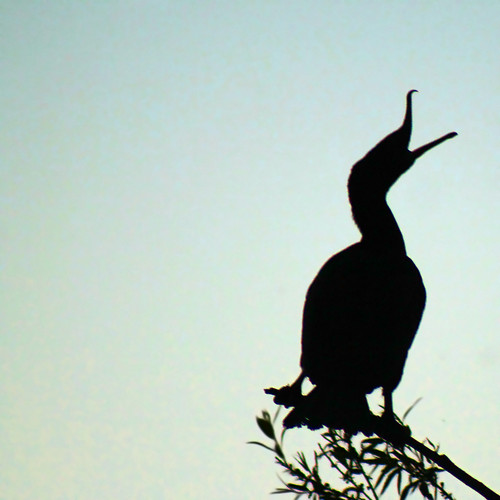 Voracious gulpers of fish and chasers of one another. Distinctive face. How has no one made a cartoon character out of one of these guys?
Seen at water holes all around, but we especially like the ones at the Gilbert Riparian Preserve (they also have neotropic cormorants, but word has it that double-cresteds are more common, and that, along with the bill and tail lengths, cinched it for me, I think). These guys have personality -- cormorality? Whatever. They're hilarious. Instead of chirping or squawking, they have a kind of burping noise that they make at one another. And they make it all the time. If you go toward the back of the preserve on most evenings, you can hear them preparing to roost in some of the large trees; dozens and dozens of them, into the hundreds, maybe. Each time a new cormorant comes to the tree, it steals an already-occupied branch, sending the occupant careening to grab another branch, often another occupied one, and so on. There are usually free branches, but they rarely go for those. They steal and bicker, in an enormous chorus of irritated belches.
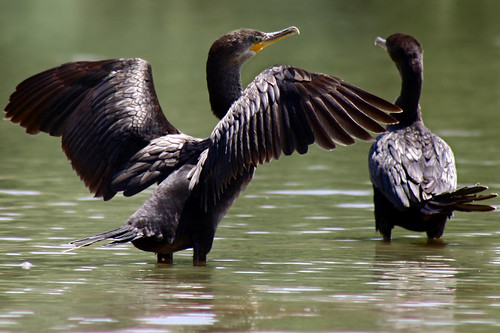
They act kind of the same when they're fishing, or even just standing around. I really kind of dig the perpetually glaring turquoise gaze and that grimace of a bill. (My son and husband theorize it's because I see myself in the derisive glare and constant scolding. To which I say ... Hey! Get off my seat!)
Day 9: Great egret
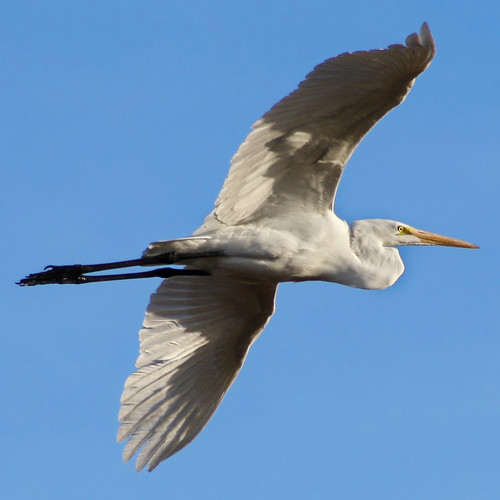
Ardea alba, also known as the Great White Egret, or bird way to gorgeous to make droppings the size of my entire body.
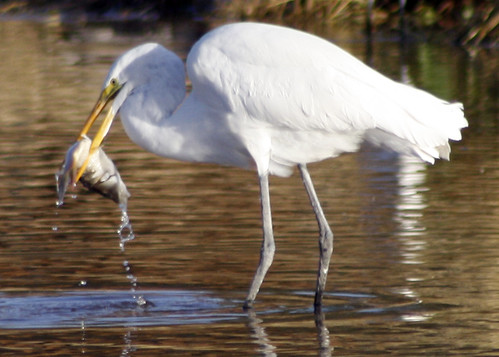
Love these guys. I miss about 95 percent of the shots I attempt, especially when they're flying, mostly because they're more fun to watch. Their expansive white wings and back carve a graceful arch through the air. Their long necks form tucked in S shapes as the sharp bills cut the air. Even their feet -- a little gnarled and scaly close up -- trail pin-straight behind them in a graceful black tail. When they brake to land, the feet pull up and the wings spread, and light bleeds through each overlapping feather, stark-white alternating with gray elliptical accents, like a series of ethereal Venn diagrams.

(It can't all be nature rhapsodizing. I'm still a dork.)
Day 10: Wolf spider (I think)
I'm the spider gal, but I'm not an expert at identifying them all. After all, my favorite spiders are some of the most readily identifiable, and I still run into quandaries.

This one was tough for me, but the eye orientation, legs, and general body structure and size on this one have me thinking it's a wolf spider in the Rabidosa genus. That means "rabid" wolf spider, by the way, and I think it's an apt name for really any wolf spider. I'm not scared of them, mind you. (I know. I'm nuts.) But that doesn't mean, if I have the lens nearly touching the thing and it decides to run for me at Mach 10, that I'm not going to jump back a few feet.
These live in our garage sometimes. Don't tell my husband.
Day 11: House finch
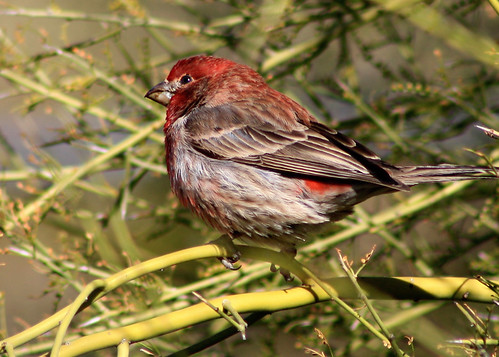
A male house finch, Carpodacus mexicanus, in a paloverde. I really should photograph these guys more often.
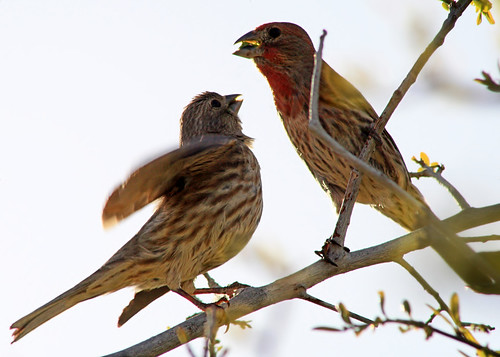
Common. But also gorgeous. House finches started as residents of Mexico and the Southwestern United States, but have been introduced and sold (illegally) throughout the rest of the country over the years. In most cases, they've settled readily, foraging for seeds and grains wherever they happen to be. Whether you lament the species they might have displaced or are happy to see the little guys, you've got to admit, as one online friend put it when I posted the picture: "Everywhere we go, from forest to desert, New England to Arizona, house finches are there. Nesting in eaves, nesting in chollas, nearly always singing ... this bird's got game!"
Day 12: Small milkweed bug
A small milkweed bug, Lygaeus kalmii, on my fingertip. I remember these as some of the first splashes of color I saw in the insects that shared our backyard growing up. I'd seen ladybugs before, and we had a ton of insects (and arachnids) that were variations of brown, gray, and black; but these were so pretty, with their vivid red Xs over the black and gray. I thought they were terribly exotic. For a while, there were black-and-red as well as black-and-orange milkweed bugs that would appear every year for a few weeks on a plant between my house and the bus stop. I would rush to check on them each day. It was one of the first wildlife obsessions I had, and it was just this common little bug. It's funny what inspires us.
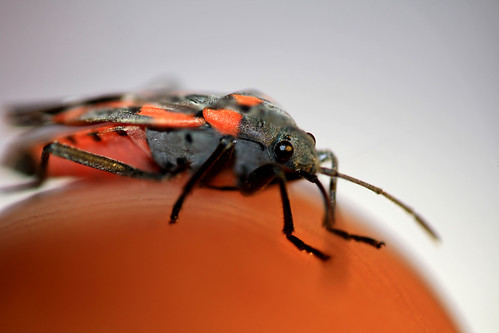
I still think they're gorgeous. Specialized too -- the sap of the milkweed plant on which they feed is poisonous and gummy, and can wreak havoc with most things that try to eat it. Milkweed bugs have specialized piercing and sucking mouth parts (if my husband is reading this, you can stop snickering now) that avoid the bad stuff and get the good stuff. They also feed on other nectars, and have been known to forage when food sources are scarce. They lay eggs on milkweed plants in the spring.
Day 13: Anna's hummingbird
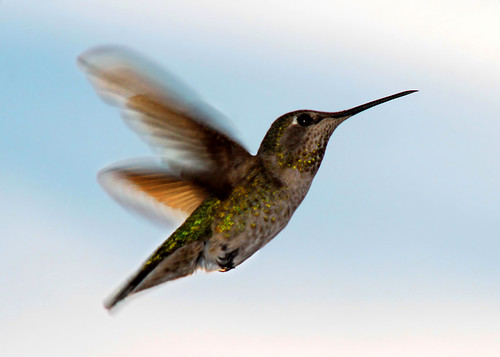
Anna's hummingbirds, Calypte anna, are abundant this time of year. I
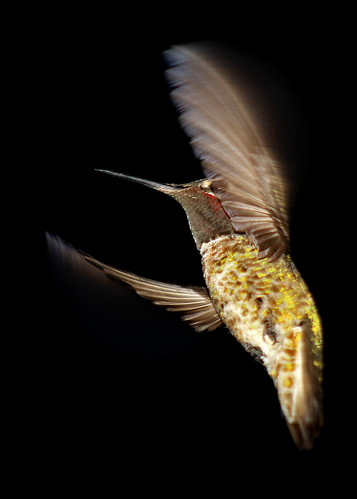 believe we have at least two nests of them in the trees around our backyard, and our hummingbird feeder is perpetually, well, humming. Their bodies are gilded in green with bronze highlights, and the males have flashy red heads.
Anna's are huge nectar feeders, and so are also important pollinators. They supplement their diet with tiny insects, which they somehow snatch out of mid-air with wide-open bills. They're feisty and aggressive -- I'm dive-bombed nearly every time I visit my own backyard -- and they sing, a lot, which is pretty unusual for hummingbirds. Their song is usually a series of raspy squeaks, but they do make a louder noise, which has been said to be produced by the tail feathers. It's during the courtship/territory display the male puts on. When a female enters his territory (which seems to equate to "anything I can see or might possibly feel like claiming"), the male Anna's climbs to almost 100 feet, until he becomes a speck in the sky and almost disappears. Then, he falls. Plummets. At the last second, right beside the female, he veers off wildly and lets out an explosive shriek. It's really something to see. Just try not to unwittingly walk right beneath the display, or 1) you'll have a very angry hummingbird; and 2) you'll look extremely foolish, fearfully shielding yourself from something that is four inches long.

Day 14: Black-necked stilts
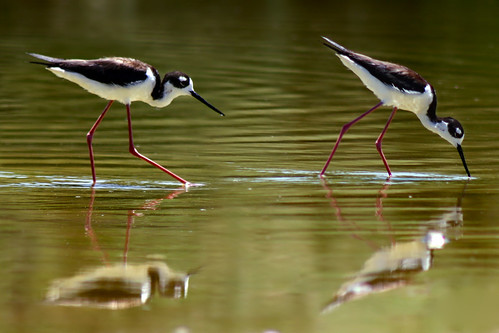
Black-necked stilts, Himantopus mexicanus, are another common sight at the Gilbert Riparian Preserve.
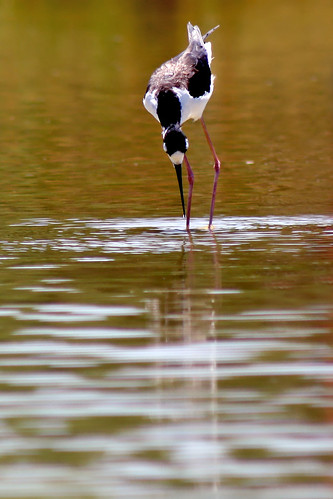 Whenever I see these guys, I can't believe how fragile they look. The spindly pink legs, the thin bill. Even their painted look and the prissy way they walk. They just look to delicate to be allowed. They certainly manage. Though they're hunted by some animals, especially feral cat colonies, their numbers are staying strong for the most part. They're common migrants in Arizona, but they also breed here.
I think they do catch small fish from time to time, but mostly, they forage. They stalk daintily through the shallows, scouting the water and mud for tiny invertebrates that I never see until they pluck them up.
Also, they're noisy. Courtship, territorial disputes, annoyance at bird watchers and photographers ... if you can't see any stilts, just listen. They're probably making noise right now.
Subscribe to:
Posts (Atom)