Oh my gosh, you guys. I'm really behind on this Species a Day thing.
Thanks a lot, summer vacation. With your trips and quality family time and whatnot. Don't you know when I don't have time to write properly, I get all rambly? Seriously, vacation self, I take forever to write a short essay, but give me a time limit, and I turn in William Faulkner or F. Scott Fitzgerald, only without the heavy drinking or the talent. And no one wants to read 4,500 words on scorpion mating habits. It takes more time to write less. So now I get to pay for it, while Summer Break Kim rests up for a brief stint of screwing me over again come winter break.
Some critters. And only some brevity.
Day 71: Least sandpiper, Calidris minutilla
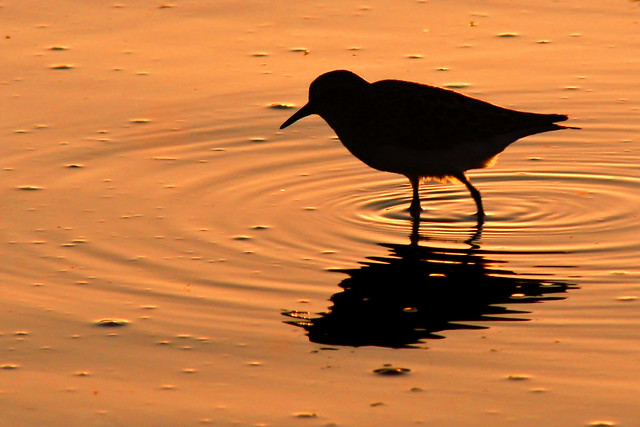 My peeps. Literally.
Of the smaller North American sandpipers, the five smallest species are so similar; their differences so subtle, headache-causing, and bird-nerd-fight inducing; that they're often just collectively called "peeps." Of these, the smallest is the least sandpiper. I only know them because 1) I have friends who are even bigger bird nerds than I am; 2) they're the ones that make their homes at the Gilbert Riparian Preserve; and 3) only the least, as far as I know, has dark brown upperparts.

We find these sandpipers throughout much of the year at the preserve, one of our go-to bird-spotting spots, though their winter and migratory ranges cover most of Arizona. They're one of the more unassuming shorebirds, timidly picking their way through the shallows, avoiding the larger stilts and avocets. You also can tell them by their shrill - you guessed it - peeping. They seem to enjoy games of chase, pursuing one another over the muddy flats with exaggerated rapid-fire strides and spins that seem to be out of a Charlie Chaplin movie. I keep waiting for the comical stare and piano music.
They're the least peeps, but they're definitely one of our main peeps.
(Yes; these are the puns you can expect after my brain has been fried.)
Day 72: Green darner, Anax junius
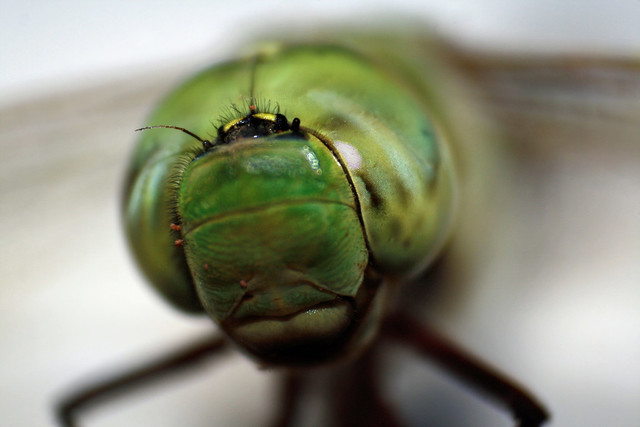
Its name translates to "king of June," or as I once read, "lord and master of June." Seriously? How awesome a name is that? I mean, I'm totally in love with all things hexapodal, and I'm not sure I'd have come up with such a cool name. It's certainly much cooler than the appropriation of their common name, darners, as a threat to sew youngsters' mouths shut.
Really, it's a perfect name. In its range -- which is wide indeed -- the acrobatic green darner rules the summer skies.
Although green darners aren't the most common dragonflies around here, they're still one of my favorites. I remember them as one of the first insects I discovered, only these were across the country in New York State's Allegany Park. The huge powerful wings, coupled with the blue and green jewel tones, were captivating. They're the most common and widespread large dragonfly in North America (though I believe the gorgeous and enormous giant darner is larger), and new information about their migration habits is still being uncovered, but it is known that they can migrate more than a thousand miles.

I saw dozens of species of dragonflies in Arizona before I saw green darners again, and when I did, it was like a gem that linked (darned?) my past and present. It's little things like this that make me really love wildlife, and insects in particular -- the closer we look, the more widely we all seem to be linked. Ugh; see what happens when I take a break? Puns, and now sappiness. At least I never made up any weird stories about dragonflies being the "devil's darning needles" to freak out my kid. (However, if you ever DO find an organism capable of sewing his mouth shut from time to time, hook me up.)
Day 73: Loggerhead shrike, Lanius ludovicianus
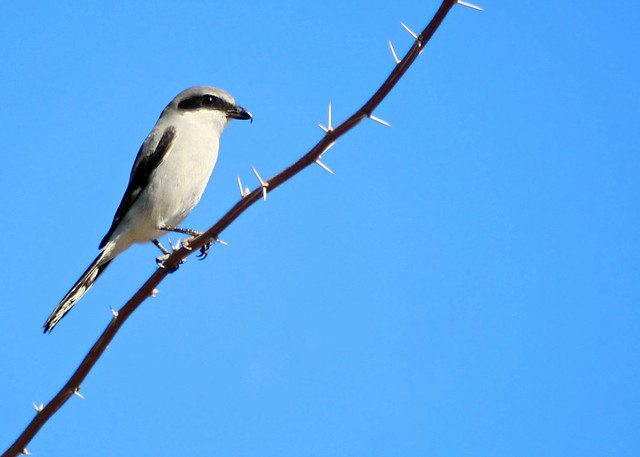
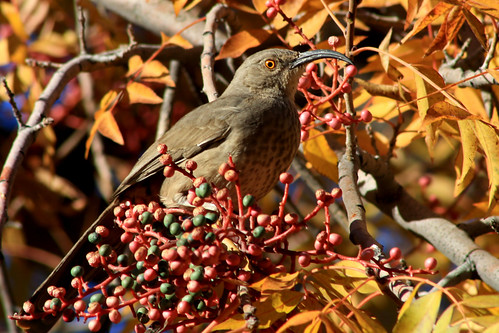
The loggerhead shrike call is usually a low warbling that crescendos into high-pitched, raspy calls; rather like its presence -- unassuming at first, but potentially fierce. This bird doesn't look much like an adept predator at first glance. It's smallish, with weak feet and no talons. The ferocity is in the acrobatic dives it can make while hunting, and especially in the beak. The loggerhead shrike's hooked beak forms a sort of tooth near the tip that helps the bird rip into its prey -- larger insects and smaller prey like lizards, mice, and other birds -- and can be used to sever the prey's spinal column. After this intense attack, the bird likes to impale its prey on a nearby branch or thorn, the better to tear it apart and wolf it down. This sweet little thing is called the "butcher bird." I think that's pretty awesome.
Day 74: Red-winged blackbird, Agelaius phoeniceus
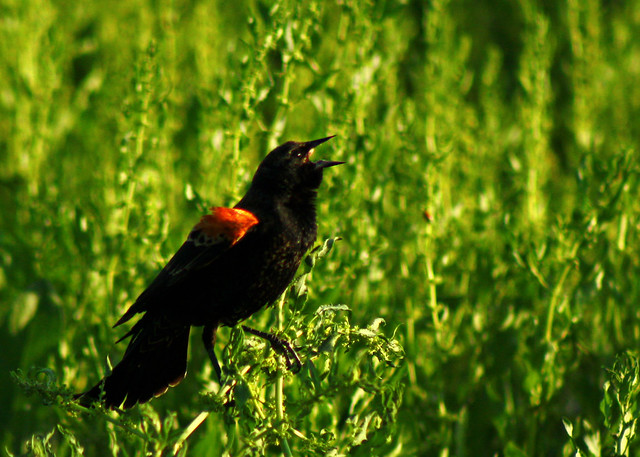
A passerine bird like the shrike, the red-winged blackbird is a bit more representative of what people picture for the order -- perching, pretty-song-singing birds. You've got the pretty -- those shoulder pads! And you've definitely got the song singing. Still, this bird's not boring. They'll defend their territory against much larger birds -- I saw one chase off a heron once -- and will dive-bomb people on occasion. The territorial displays the males put on are endlessly entertaining, and the songs are actually quite beautiful -- a liquidy, cong-a-lee that repeats over and over again, signaling the beginning of spring and, he hopes, the beginning of a mating liaison. Seriously, even a recording of their song instantly brings marshy grass, cattails, warm light and spring goodness to mind.
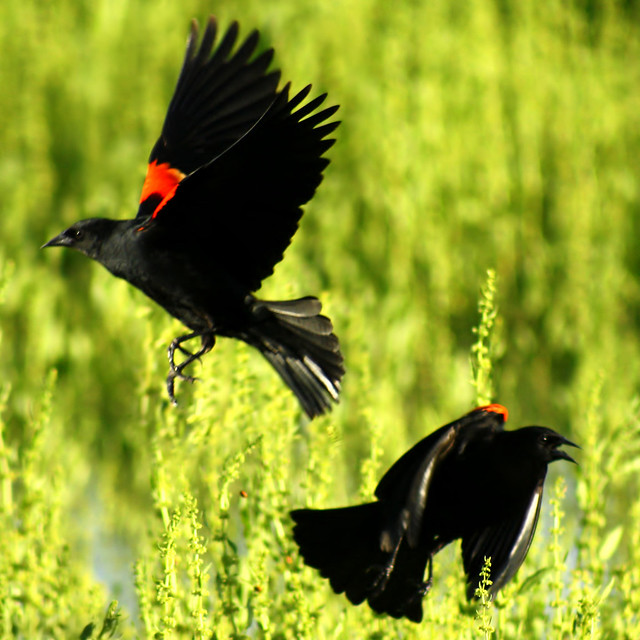
The males are the bright ones, naturally, but that just means they're the ones who need to show off, which means it's the females who do all the choosing. The males are jet black except for vivid red shoulders (they're actually called epaulets, which seems even more darling), edged by yellow. The females are streaked brown, with white eyebrows. They're both gorgeous.
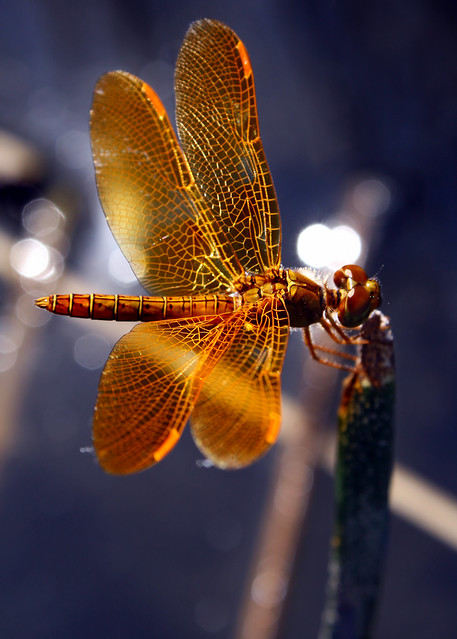
Day 75: Mexican amberwing, Perithemis intensa
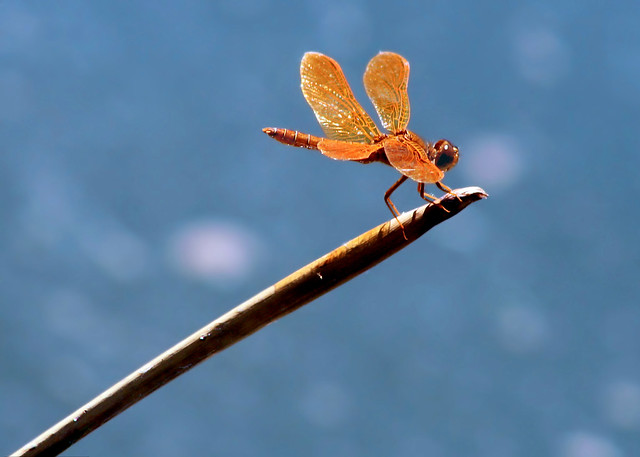
Strictly a Southwestern dragonfly, these little guys prefer shallow, warm water, which makes them a perfect fit for Arizona. They're also feisty and fierce, which I guess also makes them a pretty good fit for Arizona. You'll find Mexican amberwings perched on the grass and reeds near the water at places like the Gilbert Riparian Preserve, Saguaro and Canyon Lakes, the Boyce Thompson Arboretum, and probably a ton of other places that have warm, calm water and accommodating perches. They're entirely a rich amber-orange color, including the wings (hence the name), and the way they light up when the sun hits them is just incredible.
Day 76: Western pondhawk, Erythemis collocata

It was a dragonfly-heavy week. The western pondhawk is fairly widespread throughout the western United States and Mexico, and is a medium-sized dragonfly. The male is a subdued, dark blue color throughout the body, with a bright green face; and the females are green with a black dorsal stripe. The thing I always notice about them is how voracious they are while hunting/eating. More than once I've seen one catch a damselfly (twice while the damselflies were mating -- a twin snack pack, I guess), and once I saw one catch another dragonfly. They'll even eat other western pondhawks.

It was while photographing a western pondhawk that I first met an "Ode." That's what he called himself -- short for a human who's really into odonates, or dragonflies and damselflies. His bible was Common Dragonflies of the Southwest. He let me in on the first semi-proper dragonfly ID -- this blue dragonfly here with the green "nose" was a pondhawk; that one over there with the white nose was a blue dasher. I remember I felt like I had discovered a twofold secret society: that of the dragonflies and that of the Odes, who are so taken with the magic in these four-winged creatures that they will begin preaching their virtues almost immediately upon meeting someone; that is, if the person doesn't first ask why they are forever walking about with four dog-eared field guides, a camera, a set of binoculars, and a dilapidated notepad for new discoveries. I was an easy convert, and many hundreds of dragonfly photos (so many thousands of attempts) later, I'm coming along in my IDs.
Day 77: Jumping spider
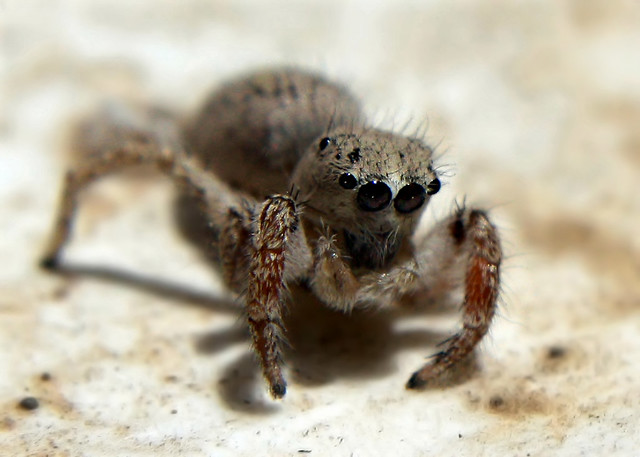
OK, so the small amount of expertise I've gained in IDing dragonflies? Totally not there with spider species. This is a brown jumping spider, which is a sucky ID. I'm pretty sure it's different than the one in the header up there (it's definitely smaller), but I'm lost otherwise. Most of the jumpers I see are "brown jumping spiders," which most field guides try to tell me is the widely distributed Platycryptus undatus, though that jumping spider is endemic to Canada and the eastern United States. I'm pegging this one as Platycryptus arizonensis, which is native to Arizona as well as California, New Mexico, and Utah; though it's possible that it's a Platycryptus californicus, which has a wider, more western, and much more north-reaching range. And more of those conclusions were clouded by the fact that these all used to belong to the genus Metacyrba and almost nobody has written anything about Platycryptus. And yeah; I know I could just be making these names up for all you know or care.
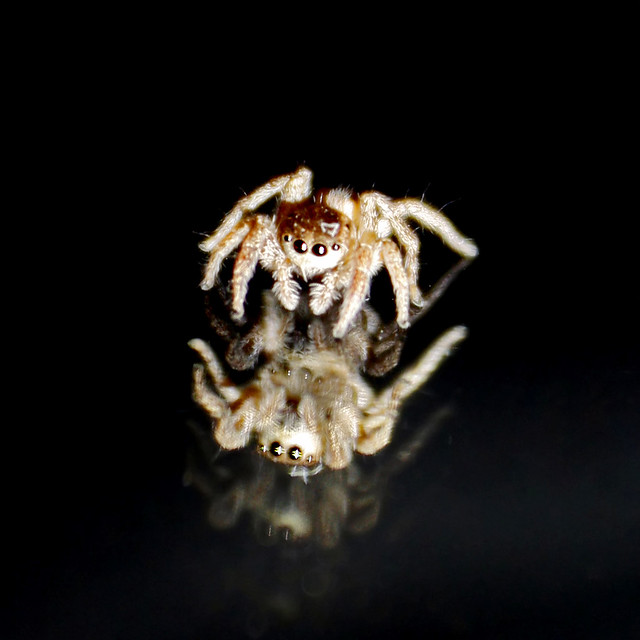
You see how this kind of thing can make you nutty? Seriously, though, taxonomy is an awesome thing. Besides the funny names for things (Colon rectum, Agra vation) and nerd fights about what species belongs in which genus (you know what I'm talking about, biologist friends), taxonomy is kind of a beautiful thing. It organizes things. You can tell a lot about an organism from how it's categorized. Platycryptus, for instance, and all jumping spiders, are squat in shape, seemingly built on the horizontal axis -- they can become almost entirely flat, the better to surprise you from between papers or layers of bark -- and only jumping spiders primarily use their eyes for hunting.
Which also means they have keen eyes for catching snoopers and photographers, so I've had precious little time with these awesome tiny creatures. If I accidentally reuse this same species, it's only because I'm too ignorant to know it, and I'm sure at least a few of you will correct me. Which, honestly, is another thing I love about online connections and wildlife obsessions.

More Species soon. What have you all be seeing in your respective necks of the woods lately?