Showing posts with label insect. Show all posts

Friday, November 18, 2011

Friday 5: Adorable arthropods

I have insect and spider shots that are better than some of these. But these are the cutest. Yes, cutest. Even people who aren't me, my son, or my buggy friends have awwwed at a few bugs now and then.

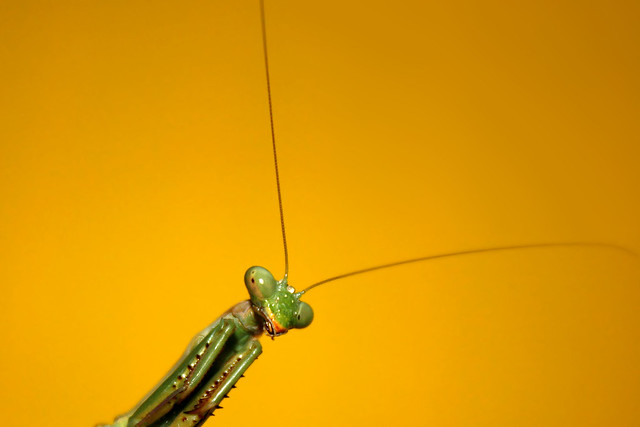
Praying mantis


Hey there! Be my friend? And feed me live flies?


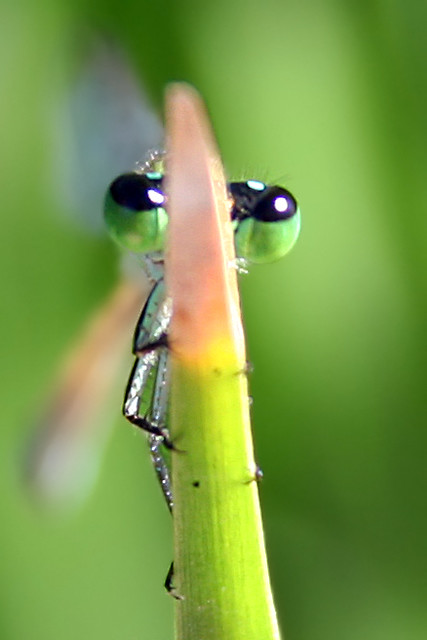
Damselfly


He probably sucks at hide and seek.


Fiery skipper


Seriously, don't you just want to pet him?


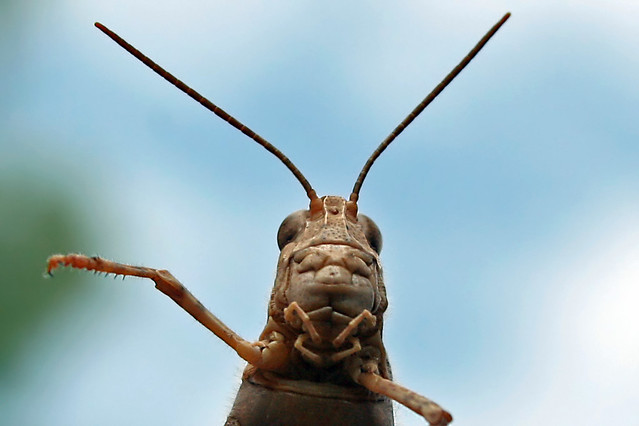
Pallid-winged grasshopper


Grouchily adorable.


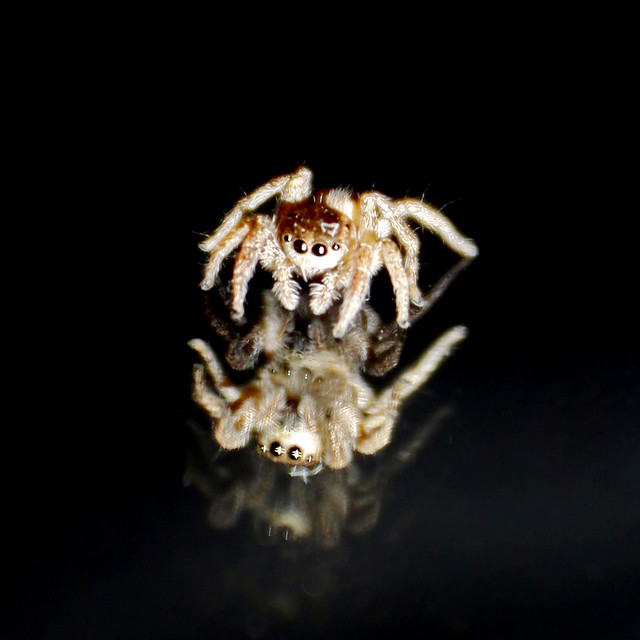
Jumping spider


If I didn't kind of hate the word, I'd squee here. Tiny cute spider! It was my writing muse for an afternoon.

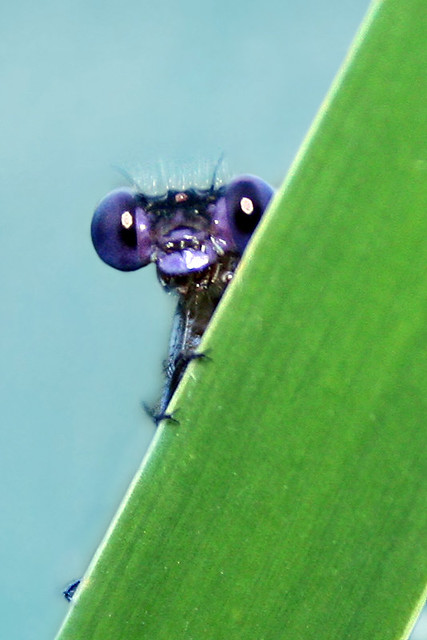
Back to regularly scheduled intelligent nature blogging this evening. Oooh, and a bonus peekaboo damselfly:

Friday, November 11, 2011

Friday 5: Mealtime

I'm a big, nature-loving softie. Still, predation is pretty cool. It's part of nature, after all. I've mentioned it here and included it in sets like this or this. Here are five more scenes I found gorgeous rather than grisly. (Your mileage, as always, will vary. My husband says if you're not me, you'll probably lean toward grisly. But he thinks I'm weird to eat during medical dramas too.)

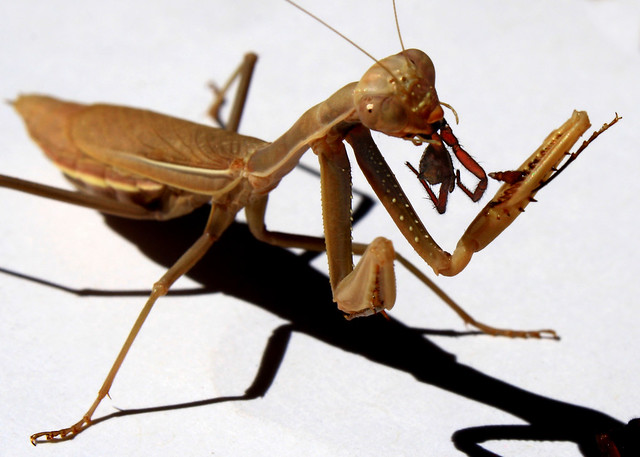
Mantis on spider:


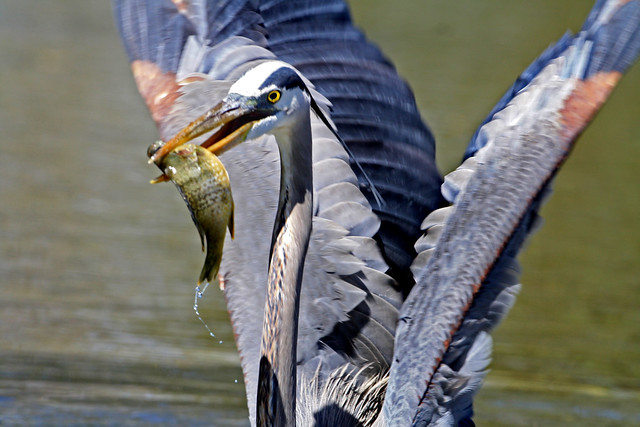
Heron on fish:


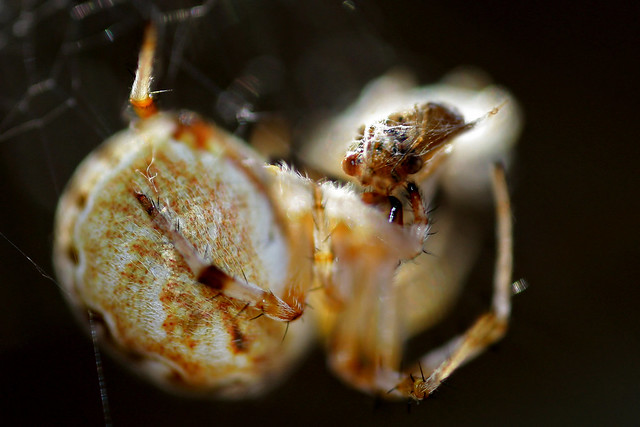
Orb weaver on cicada:


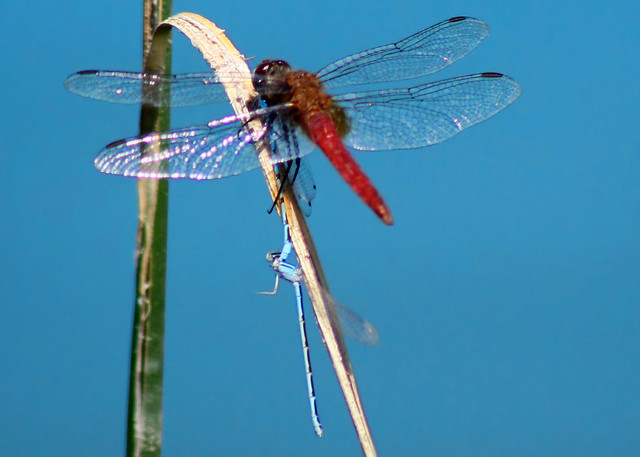
Red-tailed pennant dragonfly on mating damselflies (twin-wrapped snack pack?):


Milkweed bugs on cockroach:


Now then ... Who's hungry?

Monday, August 8, 2011

Species a Day, Week 11

Check out the rest of my Species a Day writeups here.

Oh my gosh, you guys. I'm really behind on this Species a Day thing.

Thanks a lot, summer vacation. With your trips and quality family time and whatnot. Don't you know when I don't have time to write properly, I get all rambly? Seriously, vacation self, I take forever to write a short essay, but give me a time limit, and I turn in William Faulkner or F. Scott Fitzgerald, only without the heavy drinking or the talent. And no one wants to read 4,500 words on scorpion mating habits. It takes more time to write less. So now I get to pay for it, while Summer Break Kim rests up for a brief stint of screwing me over again come winter break.

Some critters. And only some brevity.

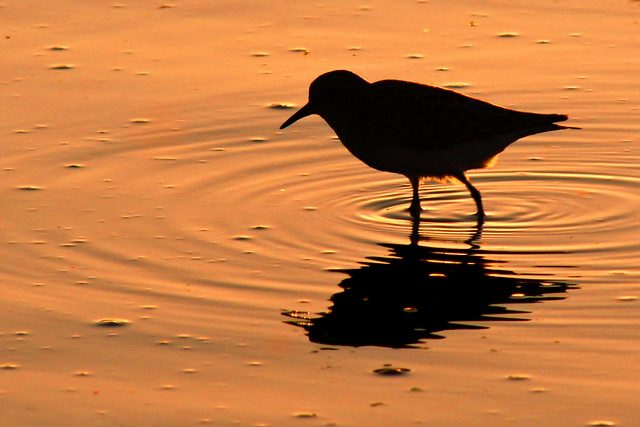
Day 71: Least sandpiper, Calidris minutilla

My peeps. Literally.

Of the smaller North American sandpipers, the five smallest species are so similar; their differences so subtle, headache-causing, and bird-nerd-fight inducing; that they're often just collectively called "peeps." Of these, the smallest is the least sandpiper. I only know them because 1) I have friends who are even bigger bird nerds than I am; 2) they're the ones that make their homes at the Gilbert Riparian Preserve; and 3) only the least, as far as I know, has dark brown upperparts.


We find these sandpipers throughout much of the year at the preserve, one of our go-to bird-spotting spots, though their winter and migratory ranges cover most of Arizona. They're one of the more unassuming shorebirds, timidly picking their way through the shallows, avoiding the larger stilts and avocets. You also can tell them by their shrill - you guessed it - peeping. They seem to enjoy games of chase, pursuing one another over the muddy flats with exaggerated rapid-fire strides and spins that seem to be out of a Charlie Chaplin movie. I keep waiting for the comical stare and piano music.

They're the least peeps, but they're definitely one of our main peeps.

(Yes; these are the puns you can expect after my brain has been fried.)

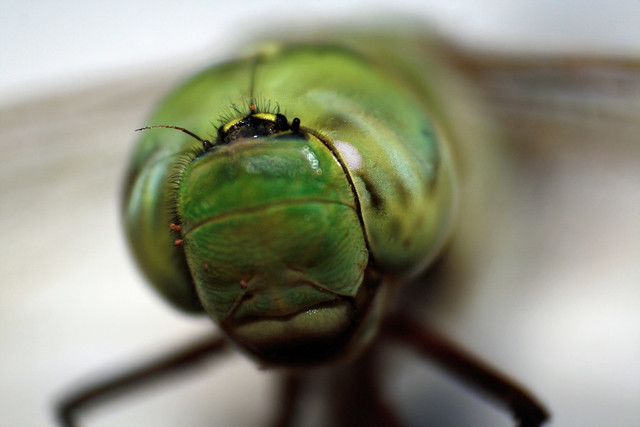
Day 72: Green darner, Anax junius


Its name translates to "king of June," or as I once read, "lord and master of June." Seriously? How awesome a name is that? I mean, I'm totally in love with all things hexapodal, and I'm not sure I'd have come up with such a cool name. It's certainly much cooler than the appropriation of their common name, darners, as a threat to sew youngsters' mouths shut.

Really, it's a perfect name. In its range -- which is wide indeed -- the acrobatic green darner rules the summer skies.

Although green darners aren't the most common dragonflies around here, they're still one of my favorites. I remember them as one of the first insects I discovered, only these were across the country in New York State's Allegany Park. The huge powerful wings, coupled with the blue and green jewel tones, were captivating. They're the most common and widespread large dragonfly in North America (though I believe the gorgeous and enormous giant darner is larger), and new information about their migration habits is still being uncovered, but it is known that they can migrate more than a thousand miles.


I saw dozens of species of dragonflies in Arizona before I saw green darners again, and when I did, it was like a gem that linked (darned?) my past and present. It's little things like this that make me really love wildlife, and insects in particular -- the closer we look, the more widely we all seem to be linked. Ugh; see what happens when I take a break? Puns, and now sappiness. At least I never made up any weird stories about dragonflies being the "devil's darning needles" to freak out my kid. (However, if you ever DO find an organism capable of sewing his mouth shut from time to time, hook me up.)

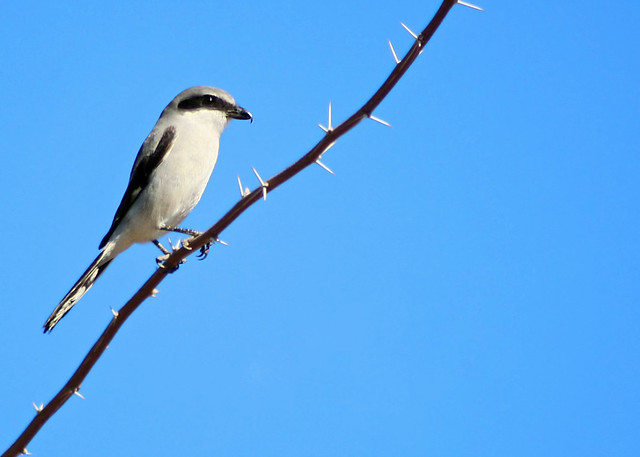
Day 73: Loggerhead shrike, Lanius ludovicianus


The loggerhead shrike call is usually a low warbling that crescendos into high-pitched, raspy calls; rather like its presence -- unassuming at first, but potentially fierce. This bird doesn't look much like an adept predator at first glance. It's smallish, with weak feet and no talons. The ferocity is in the acrobatic dives it can make while hunting, and especially in the beak. The loggerhead shrike's hooked beak forms a sort of tooth near the tip that helps the bird rip into its prey -- larger insects and smaller prey like lizards, mice, and other birds -- and can be used to sever the prey's spinal column. After this intense attack, the bird likes to impale its prey on a nearby branch or thorn, the better to tear it apart and wolf it down. This sweet little thing is called the "butcher bird." I think that's pretty awesome.

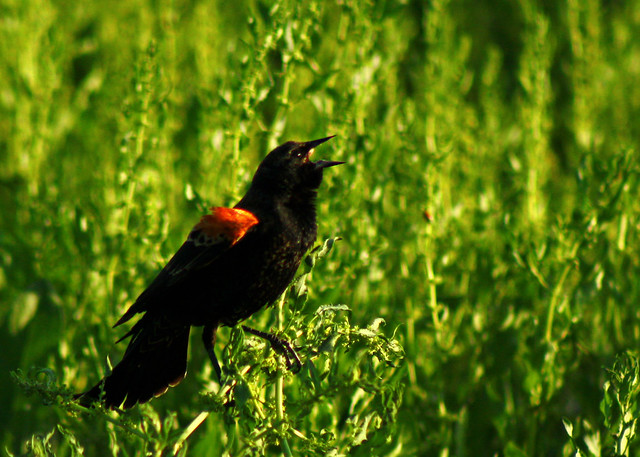
Day 74: Red-winged blackbird, Agelaius phoeniceus


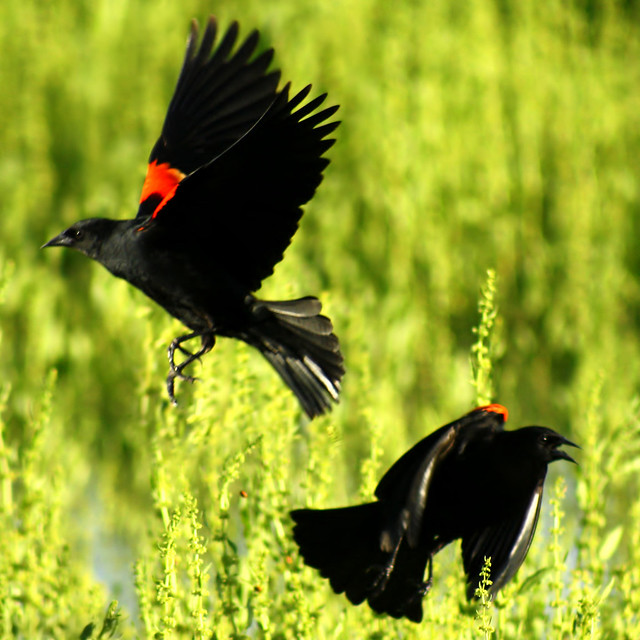
A passerine bird like the shrike, the red-winged blackbird is a bit more representative of what people picture for the order -- perching, pretty-song-singing birds. You've got the pretty -- those shoulder pads! And you've definitely got the song singing. Still, this bird's not boring. They'll defend their territory against much larger birds -- I saw one chase off a heron once -- and will dive-bomb people on occasion. The territorial displays the males put on are endlessly entertaining, and the songs are actually quite beautiful -- a liquidy, cong-a-lee that repeats over and over again, signaling the beginning of spring and, he hopes, the beginning of a mating liaison. Seriously, even a recording of their song instantly brings marshy grass, cattails, warm light and spring goodness to mind.


The males are the bright ones, naturally, but that just means they're the ones who need to show off, which means it's the females who do all the choosing. The males are jet black except for vivid red shoulders (they're actually called epaulets, which seems even more darling), edged by yellow. The females are streaked brown, with white eyebrows. They're both gorgeous.

Day 75: Mexican amberwing, Perithemis intensa


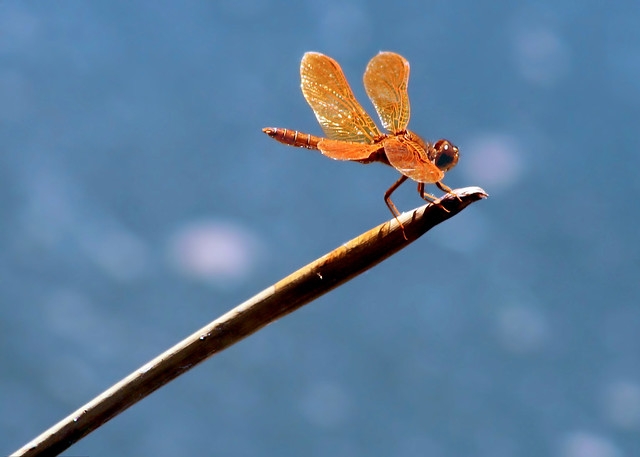
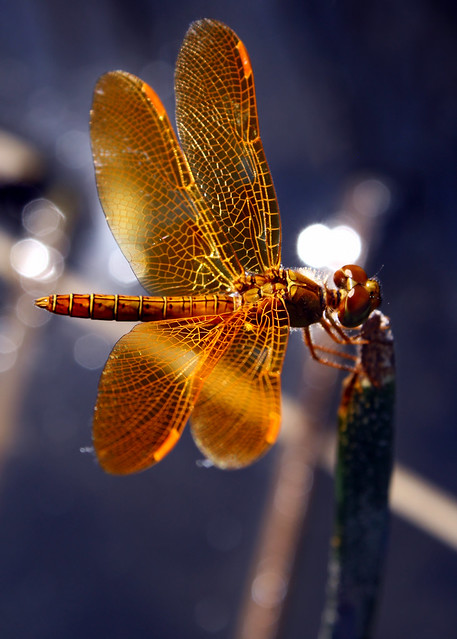
Strictly a Southwestern dragonfly, these little guys prefer shallow, warm water, which makes them a perfect fit for Arizona. They're also feisty and fierce, which I guess also makes them a pretty good fit for Arizona. You'll find Mexican amberwings perched on the grass and reeds near the water at places like the Gilbert Riparian Preserve, Saguaro and Canyon Lakes, the Boyce Thompson Arboretum, and probably a ton of other places that have warm, calm water and accommodating perches. They're entirely a rich amber-orange color, including the wings (hence the name), and the way they light up when the sun hits them is just incredible.


Day 76: Western pondhawk, Erythemis collocata


It was a dragonfly-heavy week. The western pondhawk is fairly widespread throughout the western United States and Mexico, and is a medium-sized dragonfly. The male is a subdued, dark blue color throughout the body, with a bright green face; and the females are green with a black dorsal stripe. The thing I always notice about them is how voracious they are while hunting/eating. More than once I've seen one catch a damselfly (twice while the damselflies were mating -- a twin snack pack, I guess), and once I saw one catch another dragonfly. They'll even eat other western pondhawks.


It was while photographing a western pondhawk that I first met an "Ode." That's what he called himself -- short for a human who's really into odonates, or dragonflies and damselflies. His bible was Common Dragonflies of the Southwest. He let me in on the first semi-proper dragonfly ID -- this blue dragonfly here with the green "nose" was a pondhawk; that one over there with the white nose was a blue dasher. I remember I felt like I had discovered a twofold secret society: that of the dragonflies and that of the Odes, who are so taken with the magic in these four-winged creatures that they will begin preaching their virtues almost immediately upon meeting someone; that is, if the person doesn't first ask why they are forever walking about with four dog-eared field guides, a camera, a set of binoculars, and a dilapidated notepad for new discoveries. I was an easy convert, and many hundreds of dragonfly photos (so many thousands of attempts) later, I'm coming along in my IDs.

Day 77: Jumping spider


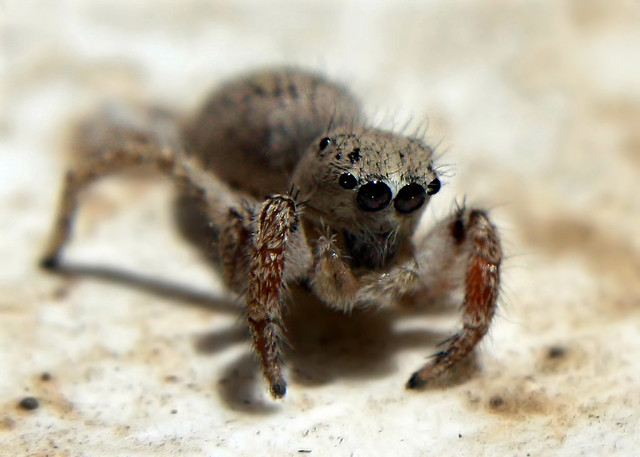
OK, so the small amount of expertise I've gained in IDing dragonflies? Totally not there with spider species. This is a brown jumping spider, which is a sucky ID. I'm pretty sure it's different than the one in the header up there (it's definitely smaller), but I'm lost otherwise. Most of the jumpers I see are "brown jumping spiders," which most field guides try to tell me is the widely distributed Platycryptus undatus, though that jumping spider is endemic to Canada and the eastern United States. I'm pegging this one as Platycryptus arizonensis, which is native to Arizona as well as California, New Mexico, and Utah; though it's possible that it's a Platycryptus californicus, which has a wider, more western, and much more north-reaching range. And more of those conclusions were clouded by the fact that these all used to belong to the genus Metacyrba and almost nobody has written anything about Platycryptus. And yeah; I know I could just be making these names up for all you know or care.


You see how this kind of thing can make you nutty? Seriously, though, taxonomy is an awesome thing. Besides the funny names for things (Colon rectum, Agra vation) and nerd fights about what species belongs in which genus (you know what I'm talking about, biologist friends), taxonomy is kind of a beautiful thing. It organizes things. You can tell a lot about an organism from how it's categorized. Platycryptus, for instance, and all jumping spiders, are squat in shape, seemingly built on the horizontal axis -- they can become almost entirely flat, the better to surprise you from between papers or layers of bark -- and only jumping spiders primarily use their eyes for hunting.

Which also means they have keen eyes for catching snoopers and photographers, so I've had precious little time with these awesome tiny creatures. If I accidentally reuse this same species, it's only because I'm too ignorant to know it, and I'm sure at least a few of you will correct me. Which, honestly, is another thing I love about online connections and wildlife obsessions.


More Species soon. What have you all be seeing in your respective necks of the woods lately?
Monday, April 18, 2011

Species a Day, Week 6

Rather than link back to all the weeks each time, I've got a separate page devoted to Species a Day posts. (You can see it up top now.) Go there to see previous weeks' posts. Each one has the animals listed, so you can see where to go at a glance.

More critters! Mostly birds. And one insect. Let me tell you 'bout the birds and the bees crane flies.

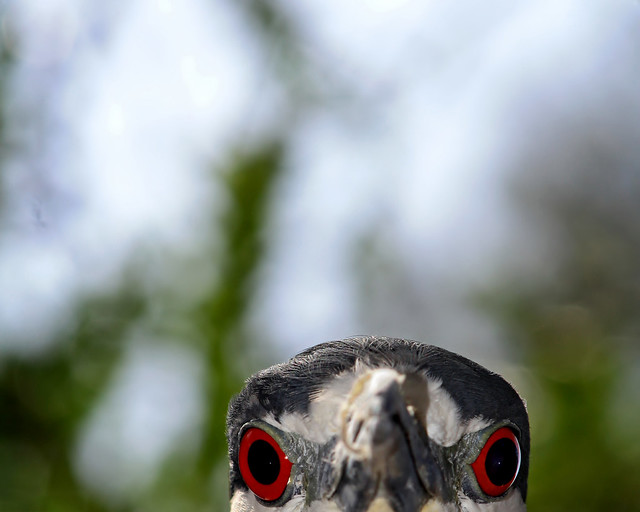
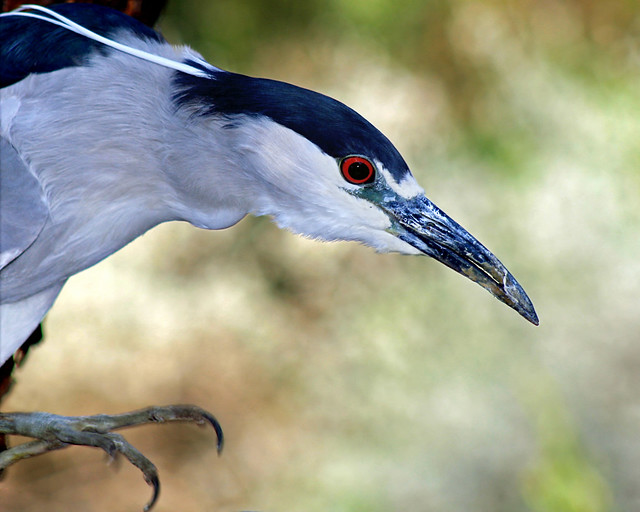
Day 36: Black-crowned night heron, Nycticorax nycticorax


The scientific name for black-crowned night heron means "night raven," and it fits them well. Their call, like the namesake, is a bark. They rest during the day, hunched in an out-of-the-way cluster of branches, but you can catch them early in the morning or late in the evening, hunting at the water's edge. No, hunting's not quite right. They ambush. These guys employ the slow-mo stalk even more than the snowy egret I mentioned last week. They're all bold grays, blacks, and whites; their eyes are fire-engine red (juveniles are a warmer, streaked brown-gray with orange-red eyes), but they seem to think nothing will see them if they move really slowly. And it seems to work. If they feel their space is being invaded, say, by an eager photographer, they let out a harsh WAAAAK and fly away while the photographer is still recovering from her cardiac event.

Black-crowned night herons are fairly common throughout their range. Look in the trees during midday or along the water's edge when shadows are long. Their necks extend surprisingly far when they see a fish, but for the most part they hunch, aiming for inconspicuousness, the better to freak you out when you startle one. Look for a grouchy football with yellow legs, beady red eyes, and a black crown.


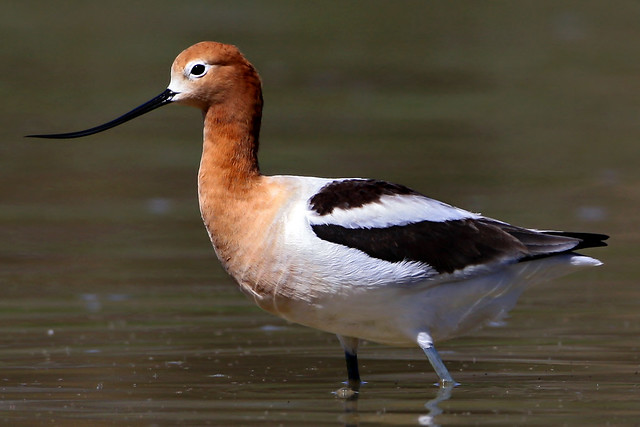
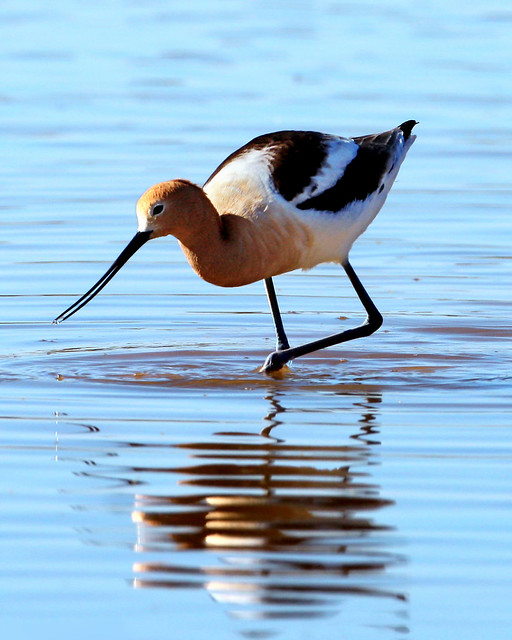
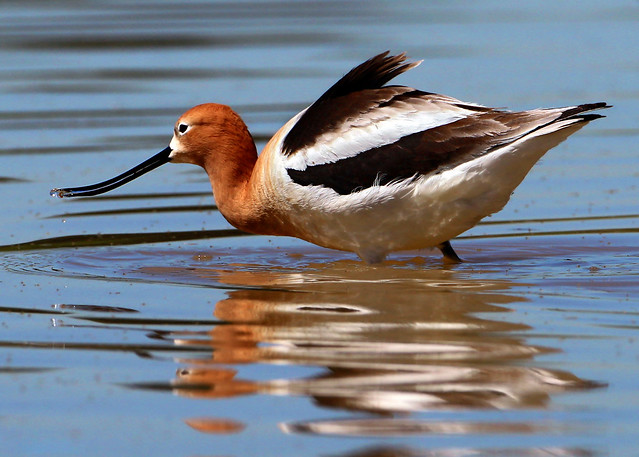
Day 37: American avocet, Recurvirostra americana

American avocets. I see them every time I visit the Gilbert Riparian Preserve, and I hardly ever capture good photos of them. That's because, as far as I can tell, they're always moving. I shouldn't feel too slighted, I suppose -- avocets are able to fool predators, not only with flight and speed but with their call. An avocet can make a series of calls that change pitch, simulating the Doppler effect and masking their true location as they approach or flee.

Avocets are in the same family as stilts, and they're often seen together. Their plumage is black and white on the back and wings and white on the belly, with rusty coloring on their head and chest in the spring and summer, when they're in breeding plumage. (The rusty feathers turn a cool gray in non-breeding winter plumage). Their legs, which trail behind them when they fly, are a gorgeous blue-gray. They are migratory, but we have some American avocets here in Arizona year-round.

Avocets feed on small animals in the water by sweeping their thin, upturned bills (the female's is slightly more upturned) in a back-and-forth motion. I never noticed until doing this that each bird feeds in a slightly different fashion -- avocets by sweeping, black-necked stilts with plunging grabs, and long-billed dowitchers with that up-and-down, up-and-down sewing-machine motion. It's like watching my son and his friends' distinct eating habits, only with the birds, no one ends up blowing his nose on a napkin or wearing a pizza-sauce Glasgow smile.


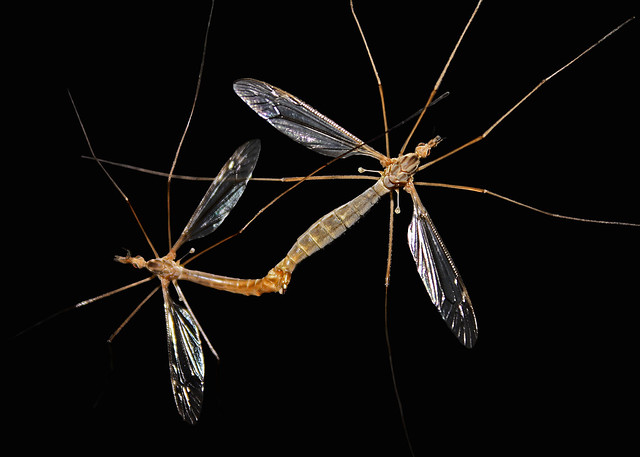
Day 38: Crane fly, Tipulidae

People freak out about these gangly insects, though they're completely harmless. Sometimes called mosquito hawks, sometimes called just "big-ass mosquitoes," and sometimes called "AGHHHGetitawayfromme," crane flies feed hardly at all, and when/if they do, it's on nectar, not blood or actual mosquitoes.

Over 4,200 species of crane flies have been described, mostly by American entomologist Charles Paul Alexander, which makes Tipulidae the largest family of Diptera (the order to which all flies belong), and makes Charles Paul Alexander someone who can make me feel either better or worse about my passion by comparison -- he described around 11,000 species and genera of flies, which works out to about one a day for his entire career. Suddenly this Species a Day thing doesn't seem nearly as ambitious.

Unfortunately, I don't have Chuck around to ask for the exact genus and species of this pair, which is just one of probably hundreds of pairs I've seen in the last few weeks. They're particularly fond of my back patio at night, particularly if a certain 9-year-old has left the patio light on even when he said it was off -- I went out this night and it was Club Crane Fly for the whole length of the house. My son, of course, responded in the most natural fashion: "Awww, cute! Look! They're all mating! They're making baby crane flies!"

(If ever I'm too worried that he'll feel pressured to conform, his entomological predilections alone should make him stand out from the crowd.)

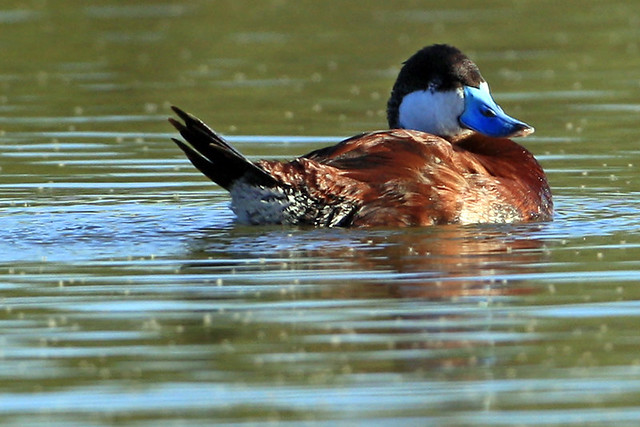
Day 39: Ruddy duck, Oxyura jamaicensis

Ruddy ducks can be see year-round in some places in Arizona, but they tend to be shy, at least in my experience, and it's only when I spot a flash of powder blue in the distance that I take a second look. The breeding plumage of the males is quite striking, with rust-red bodies, broad blue bills, white faces, and black caps. Adult females have a gray-brown bodies and the bill is duller, but they are distinguished by lovely cheek stripes. Both species are more dull colored when they have their non-mating plumage, but I guess that's OK. I only dress up a few days out of the year, so at least they have me beat.

Ruddy ducks are so named for their long, stiff tail feathers, which can act as a rudder when the birds dive.

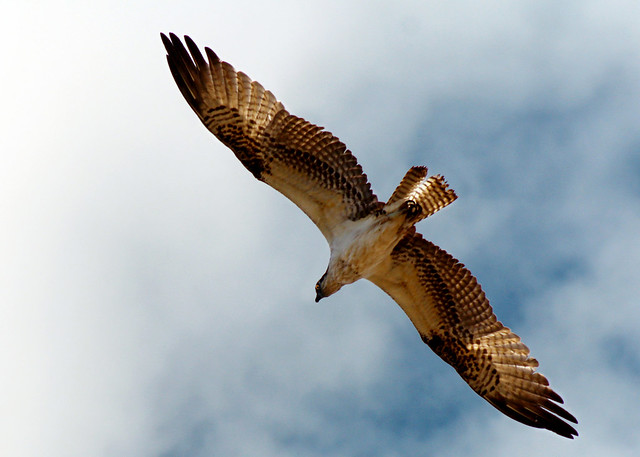
Day 40: Osprey, Pandion haliaetus

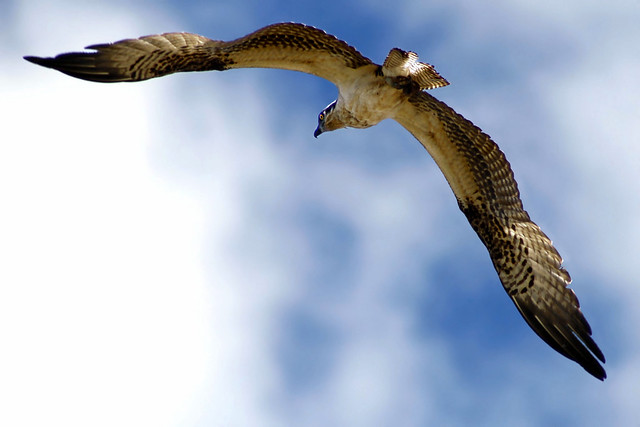
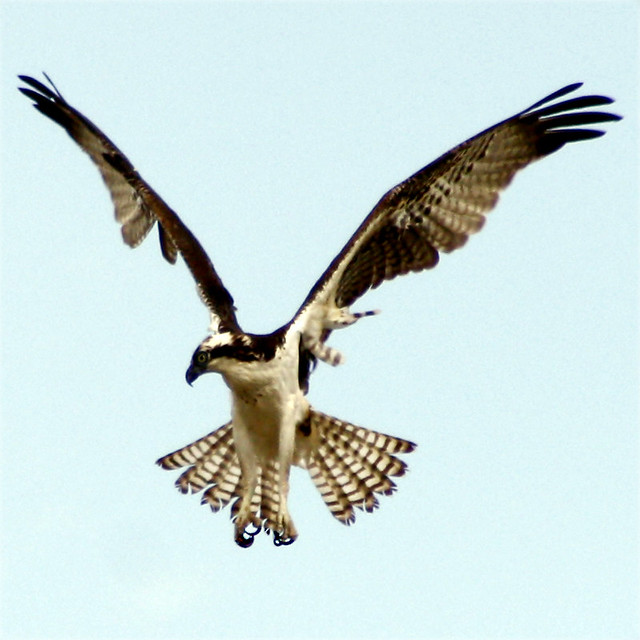
I've found some references where osprey are called "lesser eagles," though the more common, and more accurate, alternate reference is probably "fish hawk." These guys are expert fishers. Apparently rangers used to be instructed to shoot osprey on sight because they were so good at grabbing the fish from rivers and ponds.

Hopefully, we just watch them now. Seriously, it's pretty amazing. With huge round eyes, snow-white underparts, and striking long wings that bend at a sharp angle at the wrist joint, they're unmistakable if you know what to look for. If you do spot one, just watch. It will swoop above until it sees a fish, and then it plummets. Long, rounded talons (also round in cross-section) and spiky skin on the underside of the feet help them snatch fish from the water. Just about the only time ospreys don't look elegant is when they float, wings spread, on the water, before getting a secure grip on their meal and taking off again. They may nest locally wherever there are fish, and especially (in Arizona) along streams below the Mogollon Rim. You can tell the female from the male by a thin, broken "necklace" of brown across the white chest.


Day 41: Mallard, Anas platyrhynchos

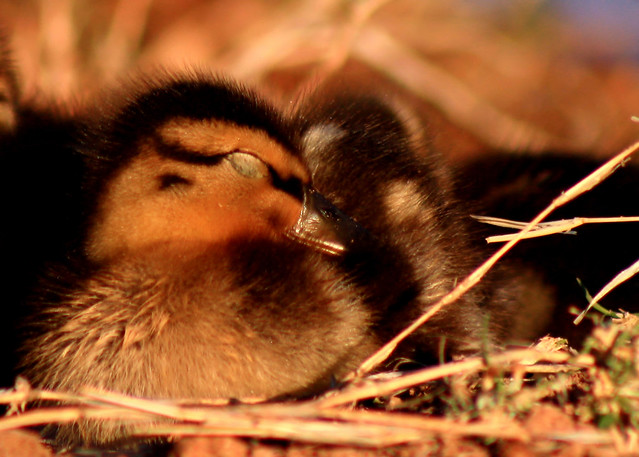
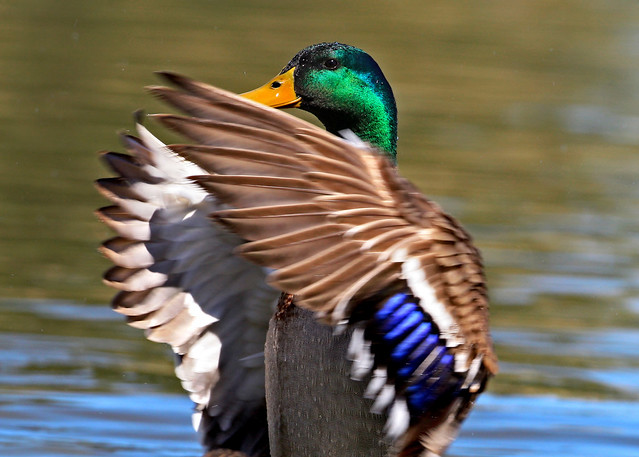
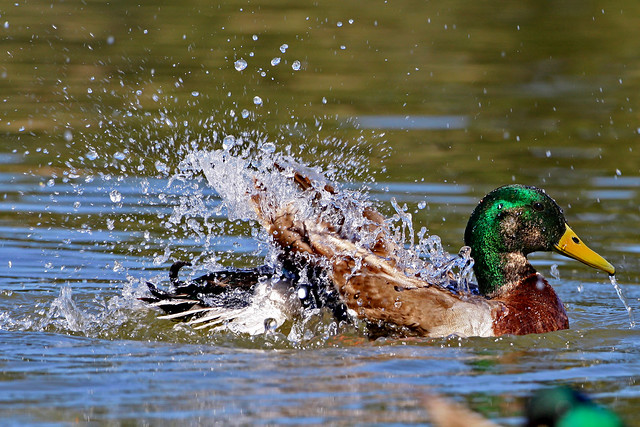
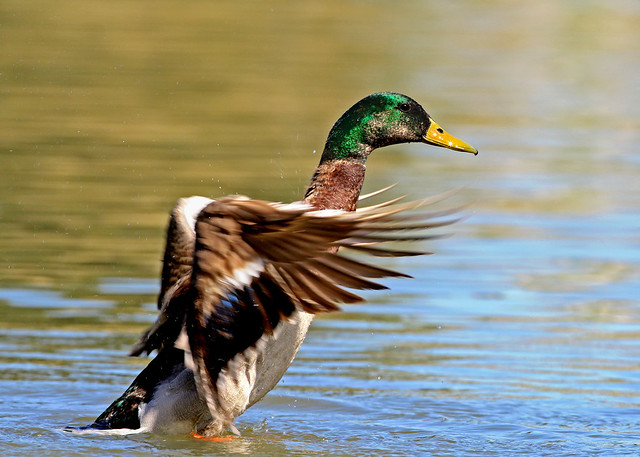
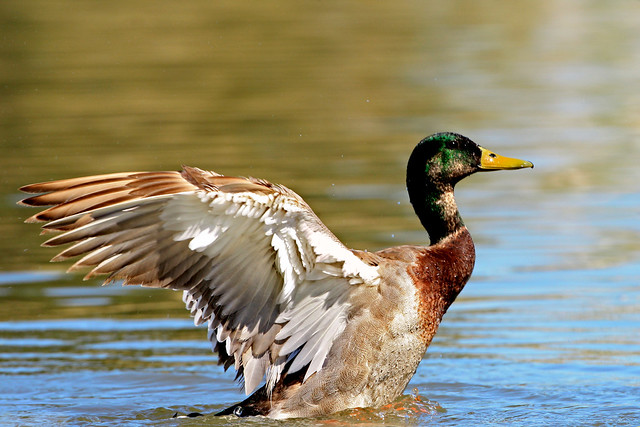
Mostly because this was too adorable to pass up. We all know what this one is. I know. Big deal. But what if someone told you there was a rare duck with striking white-and-brown plumage, deep blue wing patches, and an iridescent green head, that would come right up to you? Birders would lose their minds.
It's not rare. Still, it is gorgeous.

My son insists on visiting the ducks every time we go anywhere. He really doesn't care if there's a painted redstart or a something-or-other warbler in the trees. He doesn't care how common mallards are. He just wants to enjoy them. As with many children, mallards were his introduction to wildlife.

Kids love ducks. They're accessible, and rather big, and you can feed them. (If you're feeding ducks use corn, leafy veggies, or cat food/dog food with large amounts of cornmeal. Bread is bad for them, and they gobble this other stuff up.) I really have to hand it to ducks, putting up with so many kids and doing nothing more extreme when harassed than waddling away in an annoyed fashion. (My son has made many an enemy, and probably made me some parent enemies, by lecturing kids everywhere on proper duck treatment.)

Interestingly, a duck has been allegedly worshiped at least once ... as a demon. According to Pope Gregory IX in the thirteenth century, the demon Asmodi appeared to his followers as a duck. They danced around him, kissed him, and promptly fell into wild satanic orgies. Which probably looked something like the kids at the park.


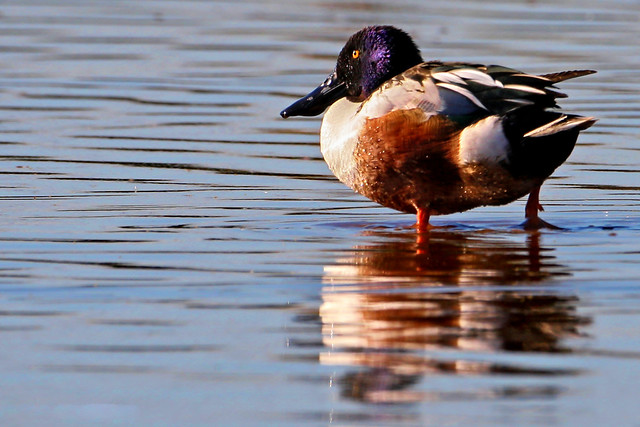
Day 42: Northern shoveler, Anas clypeata

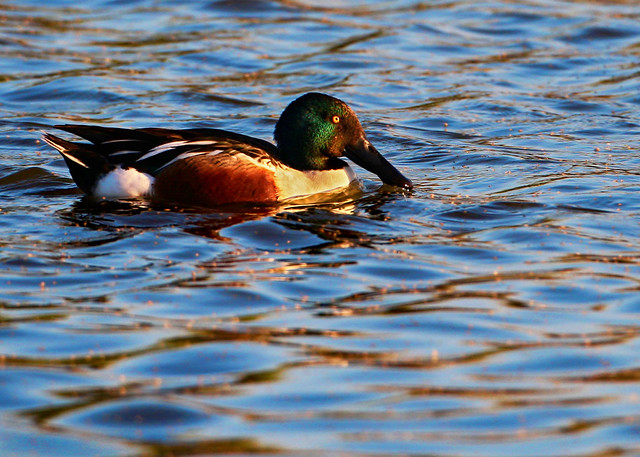
Yeah, another duck. These guys are awesome, with their improbably giant bills and vivid plumage. I guess I should include something nice about ducks after the demon story, so I can tell you that in many cultures, ducks are seen to represent connections between worlds, as they seem at home in the water, in the air, and on land. This is illustrated beautifully with shovelers, whose bills dabble up vast quantities of bugs and vegetation from the water as the sky's light hits them strikingly from any angle, highlighting the head to look forest green from one angle and deep indigo violet from another. There's even a duck creation myth in which the duck shoveled bits of mud to the top of the water to make land, and I've always imagined it to be a shoveler. The female looks similar in marking and color to a female mallard, but look for the giant bill.


That's it from me this week. What are some of your favorite recent sightings?

Friday, April 1, 2011

Species a Day, Week 4

Previous weeks:
Week 1
Week 2
Week 3

No snappy intro. Just animals. I'm double-posting after a brief break in posting, though, so catch my attempt at photography tips right before this.

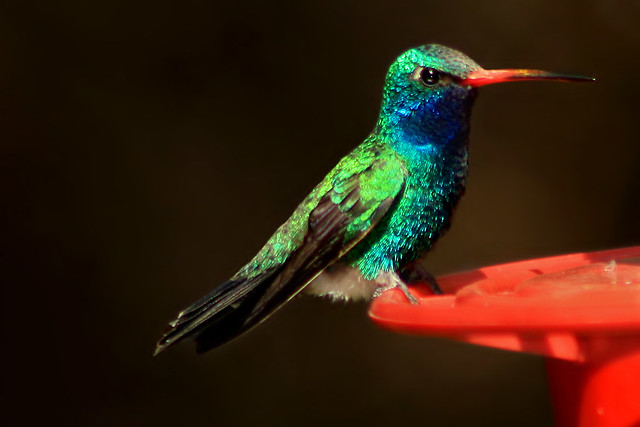
Day 22: Broad-billed hummingbird

Broad-billed hummingbirds, Cynanthus latirostris, are common summer residents in Arizona's riparian areas, and breed in parts of our state. They are readily seen at Boyce Thompson Arboretum, though not as readily photographed, as least successfully. The males are seriously, flamboyantly gorgeous. Metallic blue and green plumage, deep blue throat feathers, bright red bill. The females are duller in color -- poor female hummingbirds. They never get the spotlight.


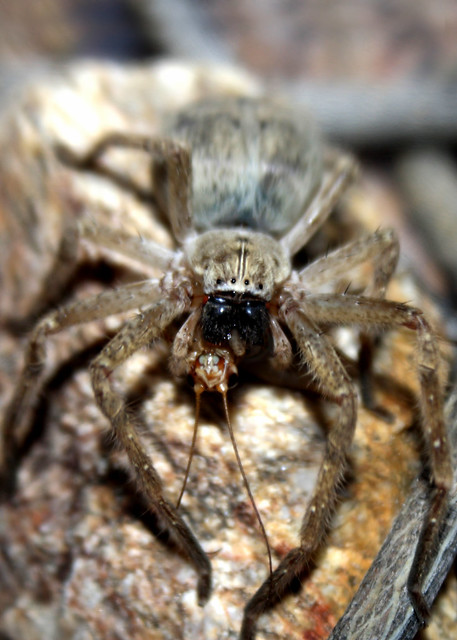
Day 23: Giant crab spider

The broad-billed started the week on a high note, but this one turned out to be my favorite, if only because of the story. I was avoiding work checking my e-mail, and noticed a message from my mom entitled "Spider question." She had "found a GIANT SPIDER" in her shed, and had questions.

Now, most people's questions would involve "Is it poisonous?" and "How do I get rid of it?" But it's my mom, and you probably figure I must get it from somewhere, so you should be unsurprised that: 1) she knows the difference between "venomous" and "poisonous" and would never ask such a ridiculous question (the reference material she sent me had "poisonous" incredulously highlighted); and 2) she didn't want to get rid of it. She made a habitat for it, complete with desert rocks and twigs, a tiny cap of water, and a supply of crickets and grasshoppers.

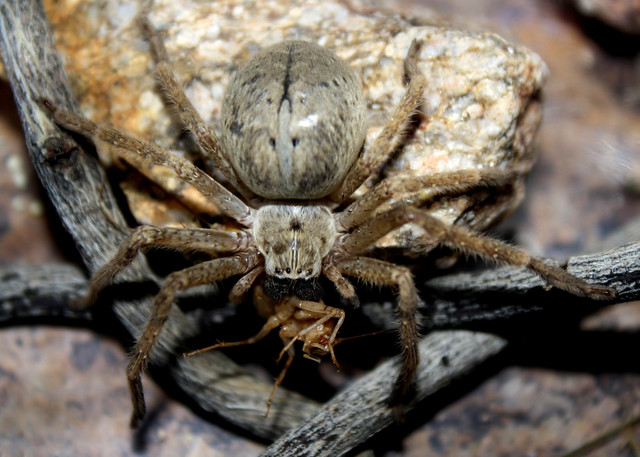
That weekend, I came over with my camera to photograph the beauty, which we'd by now tentatively identified as a giant crab spider, Olios giganteus. I knelt beside the spider. I scooted beneath her. My mom lifted the container up to the light. We discussed whether the dining room light was hitting the chelicerae sufficiently. The rest of my family looked at us as though we were crazy.

I took her home, intending to get some even better shots in my "spider studio" I've set up (which may or may not involve a pair of my husband's pants as a backdrop; shhh). I released her. Then, I lost the pictures. Figuring it was a lost cause, I went back to the field to check for her, and found her again, clinging to a rock. She allowed me to scoop her back into her "home." However, I still don't have pictures, because she went into hiding. Don't worry; I haven't lost her. She's now woven a cocoon around herself, which could mean she's going to lay eggs. I'm very happy about this.


In the meantime, Lynette from BugGuide.Net contacted me to ask me to contribute the above photo to their site, and also filled me in on the cloudy taxonomy of Olios spiders. Apparently, we have nine species of the genus in the United States, and according to this site, we have five of them in Arizona. She also passed on that the genus hasn't really ever been thoroughly studied since the species writeups 75 years ago. Taxonomy can be a contentious and confusing field, so I'll leave it at genus for now. Still. More adventures in spider raising. Hooray! (Thanks, Mom.)

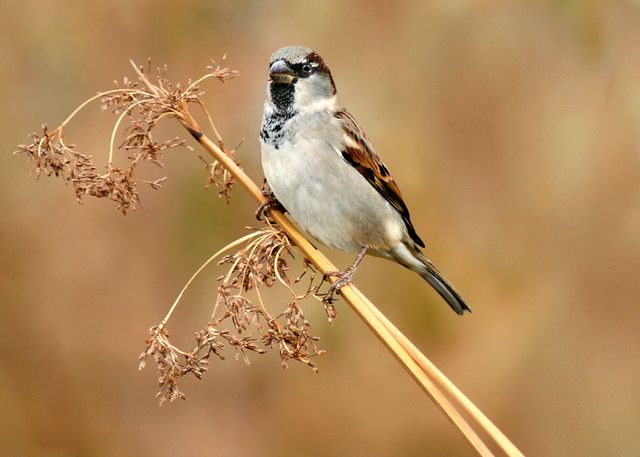
Day 24: House sparrow

The house sparrow (Passer domesticus) is not originally an Arizonan, but it's been here for a while. It can be destructive. It's boring. It's considered a "junk bird" by birders and photographers.

And sometimes, it's pretty gorgeous.


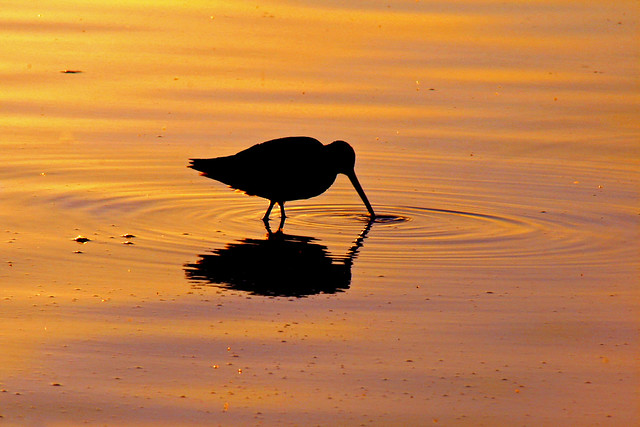
Day 25: Long-billed dowitcher

They're one of the "other birds" wading in the ponds at places like the Gilbert Riparian Preserve. Long-billed dowitchers (we don't usually have the short-billed kind), Limnodromus scolopaceus, wade through the shallows and pluck small creatures up like little avian sewing machines. I usually overlook them in favor of the herons, egrets, and stilts. Maybe I'll make an effort to capture more of them.


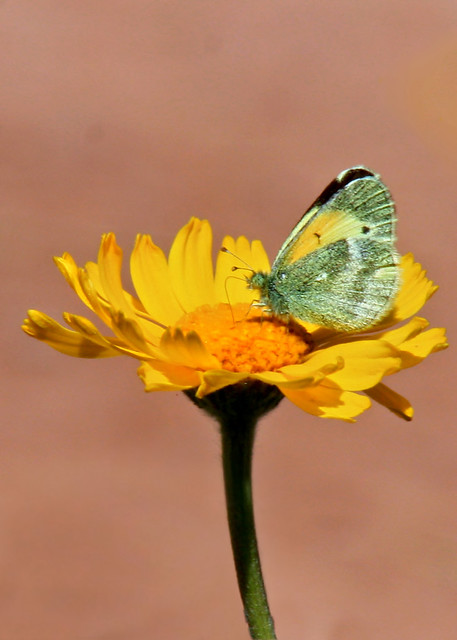
Day 26: Dainty sulphur


The dainty sulphur (Nathalis iole) is the smallest butterfly in its family, and these guys are hard to capture. They flit from one flower to the next, and nearly all my shots are of an empty flower. But they really are gorgeous when you stop to look at them. The males flutter inches above the ground in search of females, and if the lady seems reluctant, they prominently display their dorsal bars and their androconial spots. Ooh, baby.


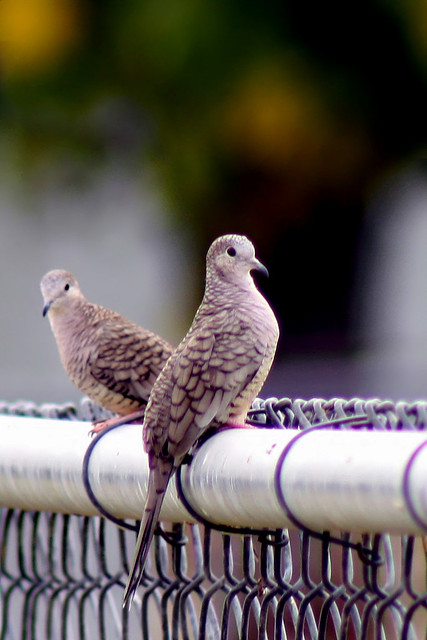
Day 27: Inca dove

Smaller than mourning and white-winged doves, Inca doves (Scardafella inca, though the genus has been debated) are also a little more timid. You can tell them by the scaled pattern on their wings and bodies -- my son says they look like pine cones. I almost never see one alone. They're always in pairs or groups. Incas range through the Southwest into Mexico and Central America, and don't live anywhere that the Inca empire ever occupied. Go figure.


Day 28: Black Saddlebags

This is what I love about the Internet. I had missed a detail on my own photo and couldn't ID this dragonfly. Because I'm contacts with so many expert IDers, I posted it, and within a day, I had it. Credit goes to Jeff (vai_boy) from Flickr for the ID. It is, of course, a black saddlebags (you can see the "saddlebags" on the wings below its body, though they don't show up really well in this shot).

Black saddlebags, or Tramea lacerata, are skimmer dragonflies found throughout the continent, especially near ponds or bodies of still water. They especially like to eat mosquito larvae, so these are good guys to have around.

They also have an interesting reproductive adaptation. Because the female only mates once, storing the sperm for fertilization, another male who mates with her will remove the previous sperm with a special sperm-removal brush. See? And you thought you wouldn't learn anything new here.


More next week. I've already got four birds, so I'll try and mix it up with an insect or mammal. Or spider, of course.