This has nothing to do with Arizona, per se. It also has nothing to do with me or my parenting, because it's not a decision on which I have ever wavered one scintilla since my son was born. We shall return to our regularly scheduled programming (I even might have a regular schedule! How d'ya like that?), but first, this:
Vaccinate your kids.
I'm sure you've all read by now -- the study's been known to be bogus for years and years now, but dangerous ignoramuses have made the issue much, much bigger than it ever had to be -- that the infamous 1998 Andrew Wakefield study linking autism and vaccines, published in the Lancet, is a fraud. This is slightly new news because not only have there been numerous studies since then showing no link between the two; not only have even the supposed "triggers" in vaccines been removed (no effect on autism rates was observed, except maybe a rise due, probably, to diagnostic improvements); not only have most of the co-authors dropped out and just about everyone disavowed the findings ... the study is out-and-out fraud. FRAUD. Fake. Garbage. Bullshit. And everyone knows it now.
So vaccinate your kids.
This moron is either lying through his teeth, or is in the deepest denial I've ever seen, but I don't really care which. Now avert your eyes if you are my mother, or are offended by strong language, because:
FUCK this guy.
Children have died because of what he started. Wakefield LIED in his study, he was hired by a lawyer who had it in for vaccine manufacturers, he refused to admit that he might possibly be wrong, other idiots took his bogus conclusions and ran with them, and rates of vaccine-preventable diseases -- death rates due to those diseases -- have risen. FUCK this guy.
If you were misled, I don't blame you at all. I realize I'm on the pretty extreme end of the spectrum when it comes to keeping up with these things, and probably even more extreme when it comes to detached, pragmatic, rational skepticism. I would contend that this is simply the right way to use one's brain, but I know there are drawbacks as well. I'm not so great at being sensitive. You, undoubtedly, are better at not pissing off your spouse or random Internet friends with extreme bluntness and an unquenchable need to correct others. And if you've been misled, anywhere along the way, I know it's not because you're stupid. You probably have a different circle of friends than I do. They are probably also smart parents. Many of them probably said, seemingly sensibly, that there must be something to this vaccine danger. Better safe than sorry. I get it. You were being the best parents you could.
But now it's out. It's all out; it's corroborated; you don't need to "trust the establishment." Independent researchers, doctors, reporters. They've all checked it out and come to the same conclusion. Everyone, really, but the ridiculous crack Wakefield, who might just be lying anyway. His study was FRAUD. Vaccines save lives. They do not cause (or "trigger") autism. If vaccines are readily available, and you decline to vaccinate your child, you're no less culpable than a parent who doesn't use a seat belt.
You ask me sometimes in messages, or on Facebook, or in parking lots, because you know I'm into this sort of thing. It's nothing like that this time, really. We're all "into" saving our kids. Maybe you refused vaccines before because you were trying to do just that. You were fed lies. Vaccinate your kids.
If you want to read more, here is the editorial in the British Medical journal, here is a CNN piece, and here is a slightly older comic that does a surprisingly good job explaining the whole thing. You can find countless other examples with the most cursory of Googling.
OK, OK. Inhale ... exhale. I'm not an angry person, really. If you have concerns / questions / commentary, if you agree or not, I really do want to hear about it. Are you still afraid to vaccinate your children? If you were, does this dispel any doubts? If not, what would?
Thursday, January 6, 2011


Wednesday, December 29, 2010
Sunday ritual
Someone asked me about church, and "Well, what DO you do on Sundays, then?" the other day. This is what my answer ended up being.
---------
In Apache Junction, throughout my formative years, I attended Mass every Sunday morning with my father and sister.
When it was time to sing, few besides the church choir participated. Indeed, the song selection seemed to be designed to prevent anyone without an extensive memory, and who had not faithfully learned nearly every song, from singing. Unfortunately, this did nothing to prevent us from singing.
My father was quite derisive of what he saw as an exclusionary attitude: "It looks like it's time for the CHOIR to sing," he'd say in the most disapproving, loud, projecting voice in existence. And then the choir, our friends in the pew in front of us, and we would sing. This was fine, obviously, for the choir. It was fine for my father's best friend, who was in possession of about half of his musical ear and devotion, but was approximately five million times better at singing. It was even fine for my sister and me, who would sing as well as we could, but still quietly enough to maintain some shred of dignity.
My dad, however, was quite unconcerned with dignity -- his or anyone else's. His talking voice -- deep, but not overly so; rising and falling in pitch unexpectedly; immensely carrying; animated -- was perfect for talking. It was ideal for telling funny stories, keeping a class full of sixth graders in rapt attention, coaching, emceeing the school talent show. Unfortunately, it was not ideal for singing hymns, and he didn't have a singing voice. He used this exact voice for singing, just sort of drawing out words here and there, bellowing them out.
My dad had excellent musical training and knowledge. He knew precisely how long to hold each note, how to open one's mouth for projection, how to read music. But the guy could not sing.
This did not stop him. What we ended up standing beside was a booming, six-and-a-half-foot-tall, extremely proud noise source that the entire assembly could hear quite distinctly. He would open his mouth approximately four feet wide, and seemed to especially belt out those first few or last few words of each verse during which the rest of the congregation had the good sense to trail off. Some songs elicited especially enthusiastic singing, and none more so than "Angels We Have Heard on High." The lyrics said (as I frequently reminded him) to draw out the refrain: "Glooo ... ooooor ... ooooor ... ooooria." He, however, insisted on enunciating each "O," with an added "H," which turned him into a booming, six-and-a-half-foot-tall, extremely proud, maniacal Santa Claus. And while I'm sure it only looked like this:

...which is quite embarrassing enough, it felt like this:

He was impervious to embarrassment, which I guess was OK, because my sister and I felt enough embarrassment for him, ourselves, and everyone who might attend Mass or even pass through the church that month.
Also, the sermons could be boring. I mean really spectacularly boring. I assume they occasionally had some nugget of a lesson to offer a 9-year-old and a 12-year-old, but we had long since tuned them out to the extent that we were unable to glean anything at all from them. Instead, we found ways to pass the time before the sermon wrapped up and we heard the telltale rustling of hymnals that told us it was time for the choir and my dad to sing again.
It was challenging, because we were not allowed to look like we were doing anything other than listening attentively. We were not allowed to write, draw pictures, read anything other than that day's missalette passages, fidget, talk to each other, or really even look at each other. (My dad usually sat between us.) So we found mental diversions. I knew exactly how many acoustic tiles there were to each length of the ceiling, and which ones looked mysteriously soggy. I knew how many steps led up to the altar, the exact designs on every robe the priest wore, just about everything about every altar boy and which ones could be counted upon to look like they were about to faint, and how many chairs fit in the old-person section of the church. I would compose poetry in my head, I would mentally recite poetry -- I was able to get about ten stanzas into The Raven and could recite the whole of "Jabberwocky" and Casey at the Bat -- and I remember spending several weeks one year, after I had learned rudimentary genetics in sixth grade, working out all the possible combinations of parental genetic contributions each person in Mass could have received at conception, based on their hair colors. I had to abandon the game once snowbird season began, as I was pretty sure "neon orange," "glowing blue-white," and "bald" were not the hair situations with which these folks were born.
There was more. The chairs made this pssssssht farting noise if you sat too roughly, but we nearly always got in trouble for making them do it, even the two times it was unintentional. The church was stifling year-round; since in the summer, it was an oven; and in the winter, there were about eight trillion people at each Mass. We'd stay longer than just about anyone else, watching everyone leave as my dad and his friend (also a teacher) held an impromptu school meeting. We got dragged to his mobile-trailer classroom on the way home every Sunday, and sat in the car, arguing and calculating how much, exactly, of the food in the car we could eat without his noticing (three slices of bread, one cookie, or any candy he'd forgotten).
I'm being facetious, but not much. He really was embarrassing. It really was boring. But here's the thing: I'd give anything, really just about anything in the world, to be sitting in the car after Mass with my sister and a dozen stinky basketballs, waiting for my dad to come out of his classroom so he could crank up the car radio and screech along to the Beach Boys on the way home. It was our Sunday ritual.
Now I'm the parent, but I don't embarrass my son at church. I don't do the "at church" part, that is. The "embarrass" part is coming along nicely.
We still have our Sunday ritual. The details are different. The car accompaniment is usually audio books, not Beach Boys. The destination is the Arboretum. But our devotion is the same, and like my childhood, we put our own spin on things.
When we come across something particularly photogenic but low to the ground or otherwise at an inconvenient angle, most passers-by do exactly that -- pass it by. Even some of my photographer friends make a few attempts at capturing it, but are sensible, reasonably cultured humans who would rather not sprawl on their bellies in the dirt/stick their asses in the air/lie in the middle of a clearing in front of anyone who might happen by. Not me. And while it looks about like this:

My son sees it like this:

I'm not sure if my devotion to the ritual has deepened, or if I'm worryingly close to losing all sense of dignity, or both. But I have to believe he'll look back on this, mostly, with a fond smile. It's our routine.
Besides, as foolish as I look, the dork bar has been set pretty high.
See you at the Arboretum Sunday. I'll be the one lying in the dirt beside the tarantula and the mortified eight-year-old.
---
I decided to do a separate post, devoted to our Arboretum adventures, next. In the meantime, share some of your rituals.
---------
In Apache Junction, throughout my formative years, I attended Mass every Sunday morning with my father and sister.
When it was time to sing, few besides the church choir participated. Indeed, the song selection seemed to be designed to prevent anyone without an extensive memory, and who had not faithfully learned nearly every song, from singing. Unfortunately, this did nothing to prevent us from singing.
My father was quite derisive of what he saw as an exclusionary attitude: "It looks like it's time for the CHOIR to sing," he'd say in the most disapproving, loud, projecting voice in existence. And then the choir, our friends in the pew in front of us, and we would sing. This was fine, obviously, for the choir. It was fine for my father's best friend, who was in possession of about half of his musical ear and devotion, but was approximately five million times better at singing. It was even fine for my sister and me, who would sing as well as we could, but still quietly enough to maintain some shred of dignity.
My dad, however, was quite unconcerned with dignity -- his or anyone else's. His talking voice -- deep, but not overly so; rising and falling in pitch unexpectedly; immensely carrying; animated -- was perfect for talking. It was ideal for telling funny stories, keeping a class full of sixth graders in rapt attention, coaching, emceeing the school talent show. Unfortunately, it was not ideal for singing hymns, and he didn't have a singing voice. He used this exact voice for singing, just sort of drawing out words here and there, bellowing them out.
My dad had excellent musical training and knowledge. He knew precisely how long to hold each note, how to open one's mouth for projection, how to read music. But the guy could not sing.
This did not stop him. What we ended up standing beside was a booming, six-and-a-half-foot-tall, extremely proud noise source that the entire assembly could hear quite distinctly. He would open his mouth approximately four feet wide, and seemed to especially belt out those first few or last few words of each verse during which the rest of the congregation had the good sense to trail off. Some songs elicited especially enthusiastic singing, and none more so than "Angels We Have Heard on High." The lyrics said (as I frequently reminded him) to draw out the refrain: "Glooo ... ooooor ... ooooor ... ooooria." He, however, insisted on enunciating each "O," with an added "H," which turned him into a booming, six-and-a-half-foot-tall, extremely proud, maniacal Santa Claus. And while I'm sure it only looked like this:
...which is quite embarrassing enough, it felt like this:
He was impervious to embarrassment, which I guess was OK, because my sister and I felt enough embarrassment for him, ourselves, and everyone who might attend Mass or even pass through the church that month.
Also, the sermons could be boring. I mean really spectacularly boring. I assume they occasionally had some nugget of a lesson to offer a 9-year-old and a 12-year-old, but we had long since tuned them out to the extent that we were unable to glean anything at all from them. Instead, we found ways to pass the time before the sermon wrapped up and we heard the telltale rustling of hymnals that told us it was time for the choir and my dad to sing again.
It was challenging, because we were not allowed to look like we were doing anything other than listening attentively. We were not allowed to write, draw pictures, read anything other than that day's missalette passages, fidget, talk to each other, or really even look at each other. (My dad usually sat between us.) So we found mental diversions. I knew exactly how many acoustic tiles there were to each length of the ceiling, and which ones looked mysteriously soggy. I knew how many steps led up to the altar, the exact designs on every robe the priest wore, just about everything about every altar boy and which ones could be counted upon to look like they were about to faint, and how many chairs fit in the old-person section of the church. I would compose poetry in my head, I would mentally recite poetry -- I was able to get about ten stanzas into The Raven and could recite the whole of "Jabberwocky" and Casey at the Bat -- and I remember spending several weeks one year, after I had learned rudimentary genetics in sixth grade, working out all the possible combinations of parental genetic contributions each person in Mass could have received at conception, based on their hair colors. I had to abandon the game once snowbird season began, as I was pretty sure "neon orange," "glowing blue-white," and "bald" were not the hair situations with which these folks were born.
There was more. The chairs made this pssssssht farting noise if you sat too roughly, but we nearly always got in trouble for making them do it, even the two times it was unintentional. The church was stifling year-round; since in the summer, it was an oven; and in the winter, there were about eight trillion people at each Mass. We'd stay longer than just about anyone else, watching everyone leave as my dad and his friend (also a teacher) held an impromptu school meeting. We got dragged to his mobile-trailer classroom on the way home every Sunday, and sat in the car, arguing and calculating how much, exactly, of the food in the car we could eat without his noticing (three slices of bread, one cookie, or any candy he'd forgotten).
I'm being facetious, but not much. He really was embarrassing. It really was boring. But here's the thing: I'd give anything, really just about anything in the world, to be sitting in the car after Mass with my sister and a dozen stinky basketballs, waiting for my dad to come out of his classroom so he could crank up the car radio and screech along to the Beach Boys on the way home. It was our Sunday ritual.
Now I'm the parent, but I don't embarrass my son at church. I don't do the "at church" part, that is. The "embarrass" part is coming along nicely.
We still have our Sunday ritual. The details are different. The car accompaniment is usually audio books, not Beach Boys. The destination is the Arboretum. But our devotion is the same, and like my childhood, we put our own spin on things.
When we come across something particularly photogenic but low to the ground or otherwise at an inconvenient angle, most passers-by do exactly that -- pass it by. Even some of my photographer friends make a few attempts at capturing it, but are sensible, reasonably cultured humans who would rather not sprawl on their bellies in the dirt/stick their asses in the air/lie in the middle of a clearing in front of anyone who might happen by. Not me. And while it looks about like this:
My son sees it like this:
I'm not sure if my devotion to the ritual has deepened, or if I'm worryingly close to losing all sense of dignity, or both. But I have to believe he'll look back on this, mostly, with a fond smile. It's our routine.
Besides, as foolish as I look, the dork bar has been set pretty high.
See you at the Arboretum Sunday. I'll be the one lying in the dirt beside the tarantula and the mortified eight-year-old.
---
I decided to do a separate post, devoted to our Arboretum adventures, next. In the meantime, share some of your rituals.
Thursday, December 2, 2010
Anniversary
 It's our fourth anniversary. According to Google and People Who Know Such Things, that makes it our fruit and flowers anniversary. I'm not sure we'll pull it off, even though it's just about the only one whose symbols are exactly the same things we might get anyway. My husband and I are the least rebellious people in the world, but we just don't do tradition. I think that part of our brains is missing.
Four years ago today, my husband and I got married outdoors. I walked through the winding walkway at a school amphitheater, which isn't really traditional but made a gorgeous aisle. Our pictures were taken by my sister's then-boyfriend (now husband), who was a great sport about taking the shots and and even better sport about me bossing him around about taking the shots. (We did end up with a disproportionally large amount of shots of my sister, but that was pretty cute.) Again, not terribly traditional, but they all had the kind of perfect imperfection you get with being comfortable around the camera. Before the ceremony, I came downstairs to find my ex-boyfriend's father ironing my wedding dress in the kitchen.
Nothing was traditional about the wedding, really, other than the general structure of it and the vows (the preacher had repeatedly scorned people "who think they're being all funny with their vows," so we figured we'd better not). My brother gave me away in the rehearsal, and my mom filled in at the wedding. My son was "married" to us during the ceremony as well. During various parts of the wedding, the musical flow was maintained only by shooting death glares to a rather clueless friend on a boombox, who was mostly clueless because Aaron and I had only that morning decided on the music.
My point is, we don't really do tradition. We don't avoid it, really, we just don't seem to get it. But the thing is, we're not what anyone would consider unconventional. We're boring.
I sometimes start telling parts of it with something like "It's a long story..." The ex-boyfriend's dad in my kitchen. My son in the ceremony. The school setting. Something else I just started typing, then figured it's someone else's deal and I'd better not tell the whole world, but it's a "long story" story, trust me. But truly? The stories are just odd, not really long or complicated. It's just the way it is. At least most couples who don't do tradition are exciting or exotic. We don't even hold to that tradition.
I've known Aaron since we were eleven. We were best friends for a summer, and he tried to flirt with me, though I didn't speak boy back then.
Then, we fell out of touch several years. We met again. I dated his best friend. Then Aaron and I dated, for four or five years. (See what I mean? I don't know even how long it was. I never kept track of our "dating anniversary.") We were engaged. Then we weren't.
I lived life
 . Made some good decisions, and a bunch of not-so-good ones. Worked with Aaron's mom, which was pretty darn awkward. I had a kid.
He dated my sister. I dated his best friend (the same one) again. I don't really remember the timing on all of that, but later, we just started being together all the time, and it was pretty nice. My son loved him, and I guess I figured out I did too. Finally on New Year's Eve in a parking lot, we admitted we were dating. My mom already knew. She was quite smug about it.
And then, four years ago, we married. Now we're really happy.
That's really the whole story. I've always wondered why it never feels quite as adventurous to me as people seem to think it must have been. Like I'm leaving out some hugely tumultuous time of wild indiscretion, hi-jinks, and hard-learned lessons. We have adventure stories along the way, but Our Story is really pretty boring, if unconventional.
We have fun talking about how he melodramatically pawned the first engagement ring (angrily fist-squashed into an oval), how he "dated both sisters" (a sure-fire way to gross out my brother), or how my growing illegitimate pregnancy alarmed the church ladies, but we never seem to get beyond that. We're not particularly good at avoiding it, but we're Teflon-coated or something when it comes to drama. It happens to us, but never seems to define us.
I sometimes think something's wrong with us -- shouldn't we have at least the occasional emotional-rage-turned-sweet-passion? He responds to this contention as though I've asked shouldn't we have the occasional unnecessary amputation, so I've quit voicing the concern. I think I've even quit feeling it. It's not really about settling for comfort over excitement. Really feeling comfortable with someone, enough to be wholly oneself. Freedom. Security. Release. Isn't that what people are really after when they're doing all the exciting stuff? Drunken philosophizing, spectacularly bad relationships, elaborately planned adventures that turn sour. It's all done in pursuit of the prize I already have.
I'm the most boring rebel in the world. I married the runner up.
I'm pretty damn lucky.
Tuesday, November 23, 2010
In defense of bragging

My son's photos were on display this weekend, and I'm bragging to everyone who'll listen.
One of the coolest side effects I've seen as a peripheral
 member of the parenting blogging community is the near death of parenting perfectionism. It is not necessary to have every hair or child in the proper place to be proud of one's role as a parent. In fact, it's dishonest, because we all know better. Embrace your imperfections. Make a microwave meal and camp out in front of the television once in a while. Laugh about how long it's been since your kid's had a bath. (Swimming counts, right?) It's cool. No one's perfect, and it's beautiful.
However, one of the crappy side effects of this side effect seems to be that you can't brag about your kid, or your skills at parenting, or your kid's skills at anything, without ample justification. I find myself resisting gush and pride and
 sentimentality every time I talk about my son, and I'm not so good at it. I ran into the superintendent of my son's school district the other day -- who's known me since he was the principal at my junior high, and thus insists on calling me "Kimbo," much to my son's amusement -- and aside from thinking it figured that I was wearing my holey ASU shirt and my hair in a pencil, I was stumped when he asked "What's your son been up to?" It wasn't that I didn't have an answer. I had too much answer. I didn't want to look like I was bragging.
Why the heck not? I have concise, modest, won't-take-much-of-your-time answers for most everything else in my life: job (I write. You've probably read some stuff, if you're in Arizona), life passions (Spiders. Photography. My kid. Writing.
 Not necessarily in that order), marriage (We watch nerdy sci-fi shows. We eat Panda Express. We suck at flirting), hobbies (same as passions). Why can't I have one thing that I don't rein in? What's wrong with that thing being my kid?
I guess I really don't think it's sentimentality. I won't put it all out there at once (and find tomorrow's "blog followers" at zero, no doubt, and justifiably), but I don't want to rein it in.
So, his photos. A couple of months ago at "Bye Bye Buzzards" day at Boyce Thompson Arboretum, my son followed up on a request to volunteer with Adobe Mountain Wildlife Rehabilitation
 Center, quite on his own. He'd made the request six months previously and had researched, carefully considered, and planned for it in in the intervening time. He's so much more than someone who thinks animals are kind of cool. He's in it for the long haul, and this is a kid who isn't always in a SpongeBob episode for the long haul. He asked about turning in an official application, and in the mean time, wanted to know what he could do. After watching him patiently take pictures for at least half an hour, he was invited to donate some of his work to raffle off to support the center. We used the shots seen throughout this post (all of which link to beautifully embiggened versions). They all printed beautifully at 8 x 10.
He beamed. He was introduced around, met Adobe volunteers and the coordinator, gave eloquent descriptions of his photos. ("I was five when I took this. I was focusing on the cactus but I wanted to get
 the thunderstorm in the background. I was eight when I took that one. The pond looks like a purple mirror, and I liked the effect.") At least a dozen times he was asked to meet this coordinator or that photographer, always with the introduction: "Those nature photos? Guess who took them? Guess how old he was?"
His talent was recognized, and I don't see why I shouldn't be telling everyone. He knows his way around a camera, but what's more is his eye. He has an incredible eye for things.
There should be a bumper sticker. I'm proud of my photographer. My kid could photograph your star athlete. Something. I'm bragging.
What's your kid's talent? Or one of yours? Or two of 'em, or ten. C'mon. Do some bragging.

Wednesday, November 17, 2010
Eat prey, love
We have grooves in our knees and the heels of our hands from propping ourselves so long in this position on the back porch. We watch the mantis as it dances left and right, makes a feint, sort of jigs back and forth. Finally, it flings its arms out, snatches the carcass. Stretchy goop (entrails? Do spiders have those?) dangles from its mouth as it slurps in half of an arachnid I'd saved for just this purpose. One bristly leg is the last to disappear, going in almost exactly like spaghetti. I impale the remaining portion of the body on a thin stick, using the oozing  viscera to glue it to the utensil, and hand it to my son, who offers the mantis a second bite.
We're the most fascinated spectators -- at times the only spectators -- in the clearing, watching the raptors. We watch for at least an hour. Most people pass by, snap a shot or two, identify the birds for their kids (occasionally even getting the names right), and steer them away before the hawk can tear apart its mouse or the vulture can crack the skull in her rodent. We keep watching. I think we were the only ones who didn't miss it: the sinuous lines in the smooth pink rodent muscle (the hawk had already neatly skinned her meal) as it was pulled taut, the gentle, beautiful silence of the clearish white fibers parting -- not tearing, exactly -- the soft ripping ssshk and yank of her head as she freed a chunk, the satisfied look as she tossed it down.
For a would-be vegetarian mom and a full-blown vegetarian kid, we love carnage around here.
We admire them, is what it is. Predators are awesome, and fascinating, and I have to admit a certain amount of smugness in seeing the beauty in things that gross out most folks. However, lately I really find myself just admiring their approach to life. *
I'm currently a prey animal. Life happens to me. I very much want to be a predator.
Prey animals sort of have to be pessimists. They monitor for an attack; they expect (and inevitably receive) calamity. Their entire being is adapted for withstanding an onslaught: sideways-glancing eyes, speed for flight, sheer numbers to account for replacements in the event of their probable failure.

Predators are optimists. They plan for the next windfall to be right around the bend. Talons and muscles built for seizing, forward-looking gazes, amazing ability to focus. A hawk has to know a mouse or rabbit will come along soon. A mantis has to wait, focused, on a wall ledge until a fat fly or spider presents itself, and then must grab it immediately. A bald eagle won't build a nest in an area unless the habitat is just right. Predators count on things being good, and they act on that assumption.
I know we're a bit of both, as humans. Prey and predator are both special and beautiful, and they both inspire conservation in their ways: the first is all about the fragility of nature, and the second, I think, inspires us to make the world the animals seem to see. And I really do want to be a vegetarian one day, I think. But everyone loves bunnies. On a purely how-fascinating-is-this level, predation rocks. Scavenging rocks. I can't understand why there isn't more about it out there. Maybe I'll fix that. And if I had to model a worldview after one or the other? I'm going with the predators.

If only I could get my vision to clear and my talons to work.
*My anthropomorphized version of their "approach" to life.
---
But wait, I'm including useful stuff now! Related real-life info:
Now is a great time to see red-tailed hawks in Arizona. Look up. They're on practically every other phone poll around here. Also, you know that REEEEEE! sound every raptor ever makes in movies? Well, most birds don't make that noise. But red-tailed hawks do. If you hear that, that's what probably made it.
If you're in the Phoenix area this weekend, check out the Adobe Mountain Wildlife Center open house! (That's a link to the event listing, where you can download a pdf flyer. I hate linking pdfs.) I'll be there Saturday, and my son's photographs will be up for auction.
viscera to glue it to the utensil, and hand it to my son, who offers the mantis a second bite.We're the most fascinated spectators -- at times the only spectators -- in the clearing, watching the raptors. We watch for at least an hour. Most people pass by, snap a shot or two, identify the birds for their kids (occasionally even getting the names right), and steer them away before the hawk can tear apart its mouse or the vulture can crack the skull in her rodent. We keep watching. I think we were the only ones who didn't miss it: the sinuous lines in the smooth pink rodent muscle (the hawk had already neatly skinned her meal) as it was pulled taut, the gentle, beautiful silence of the clearish white fibers parting -- not tearing, exactly -- the soft ripping ssshk and yank of her head as she freed a chunk, the satisfied look as she tossed it down.
For a would-be vegetarian mom and a full-blown vegetarian kid, we love carnage around here.
We admire them, is what it is. Predators are awesome, and fascinating, and I have to admit a certain amount of smugness in seeing the beauty in things that gross out most folks. However, lately I really find myself just admiring their approach to life. *
I'm currently a prey animal. Life happens to me. I very much want to be a predator.
Prey animals sort of have to be pessimists. They monitor for an attack; they expect (and inevitably receive) calamity. Their entire being is adapted for withstanding an onslaught: sideways-glancing eyes, speed for flight, sheer numbers to account for replacements in the event of their probable failure.
Predators are optimists. They plan for the next windfall to be right around the bend. Talons and muscles built for seizing, forward-looking gazes, amazing ability to focus. A hawk has to know a mouse or rabbit will come along soon. A mantis has to wait, focused, on a wall ledge until a fat fly or spider presents itself, and then must grab it immediately. A bald eagle won't build a nest in an area unless the habitat is just right. Predators count on things being good, and they act on that assumption.
I know we're a bit of both, as humans. Prey and predator are both special and beautiful, and they both inspire conservation in their ways: the first is all about the fragility of nature, and the second, I think, inspires us to make the world the animals seem to see. And I really do want to be a vegetarian one day, I think. But everyone loves bunnies. On a purely how-fascinating-is-this level, predation rocks. Scavenging rocks. I can't understand why there isn't more about it out there. Maybe I'll fix that. And if I had to model a worldview after one or the other? I'm going with the predators.
If only I could get my vision to clear and my talons to work.
*My anthropomorphized version of their "approach" to life.
---
But wait, I'm including useful stuff now! Related real-life info:
Now is a great time to see red-tailed hawks in Arizona. Look up. They're on practically every other phone poll around here. Also, you know that REEEEEE! sound every raptor ever makes in movies? Well, most birds don't make that noise. But red-tailed hawks do. If you hear that, that's what probably made it.
If you're in the Phoenix area this weekend, check out the Adobe Mountain Wildlife Center open house! (That's a link to the event listing, where you can download a pdf flyer. I hate linking pdfs.) I'll be there Saturday, and my son's photographs will be up for auction.
Tuesday, November 16, 2010
A peek inside my head
I've been mapping out a blog schedule of sorts, and also dealing with a host of non-blog issues. Today I sat down to finish a post. These were all the notes I found on my desk -- on little slips of paper, scribbled on the backs of envelopes, and in one case, on the inside cardboard surface of a pizza box. I thought all of these things were important enough to write down. It's not helpful in the least for my post, or the article I also need to write, but if you're wanting something to tide you over, these notes probably tell you all that you need to know about what goes on inside my head. Which is cluttered. And likes to start ideas that may or may not have legs. And likes cheese of "all kinds," apparently.
Ways my life = South Park
Eat prey, love
predation = optimism
traumatic insemination
FIND AND FILL OUT FORMS!!!
Clowns and stupid Aaron
On raising black widows
Address! Mail TODAY
David mating quote
mantis vs. mantis
Send invoice, again?
Orng chk x 2, chow mn
BJ beef, or chk, msh chk, chow mn
print/frame photos
cat litter
cat food
milk
ibuprof
Excedrin
drinks
cheese (all kinds)
kid pizzas
spontaneity story - bear encounter/dancing/braless fever
some sort of alchemy to it
post mortem photography
the idea of transformation
Call DMV
You can expect to see a few of these fleshed out in the future. Probably not the Panda Express or shopping list ones.
Thursday, October 7, 2010
A face everyone could (or should) love
 I don't think they're "pretty for something so ugly." Nor do they have "faces only a mother could love." They're not "necessary, but hideous." Not merely "fascinating." And though I will gladly take the props (seriously, make with more props; I have a huge ego and it's hungry), my photos aren't "gorgeous, especially for pictures of a vulture."
I think turkey vultures are gorgeous. Like, actually gorgeous. Photogenic. As in pretty.
I especially love this turkey vulture. Meet Ed (or meet her again, if you've already seen the several shots of her on my Flickr stream). She's a rescued turkey vulture, cared for by volunteers from the Adobe Mountain Wildlife Center. There seems to be some debate as to whether "Ed" stands for Edna or Edwina (in addition to "Education"), but she is definitely female. Everyone always assumes she's male, but I feel like I can see it in her eyes. I am, of course, imagining this. I know because they told me. Still, I feel it.
My son loves her too, as well as all turkey vultures. Vultures were one of the first animals about which he learned real facts, thanks to Ed and
 Boyce Thompson Arboretum's annual "Bye-Bye Buzzards" event in September each year (when turkey vultures prepare to migrate to Mexico) and the "Welcome Back Buzzards" get-together in March. Every kid loves animals, but this kid is different. I think I can trace it back to a few animal encounters, one of the earliest being turkey vultures. Ever since the first one he saw one up-close, he's wanted to really know them.
I could tell him quite a bit about turkey vultures, though he knows half of it already. Their ecological role ("nature's cleanup crew," as the saying goes). Their lineage. (Turkey vultures; commonly called buzzards after the name was given to them by European settlers, who thought the birds looked like their common buzzards; are actually more closely related to storks and ibises than raptors.)
I could describe the way morning light bleeds through a vulture's wings as it spreads them up to six feet wide; in a gesture said to warm the wings, dry morning dew and bake away bacteria while vultures wait to glide.
 I could describe their food-hunting prowess. Turkey vultures, possessing some of the best eyes of any land animal, rely as well on their ability to sniff out ethyl mercaptan in decaying carcasses. We could relive the story about my son trying to fart to attract turkey vultures. (Ethyl mercaptan being the pungent component in flatulance -- see how fun it is to be a sciencey family?)
I could go on about their built in swamp-cooling system, which really just involves peeing on their own legs but has a fancy scientific name, urohydrosis. Their courting ritual, which involves the male and female nibbling each other's wrinkly red heads. The proper name for a group of them (a venue, or a kettle when circling -- never a flock), their migration patterns, the way they ride air currents, their lack of a nasal septum, their cool vomiting defense, or any of a million other things. I really love these birds.
However, the thing that most gets me is their bad rap.
Of all animals to get an unfair shake in popular opinion, vultures have to top the list. The other usual suspects -- spiders, snakes, ants -- have their superheroes, smitten celebrity advocates and Disney popularizers. But even Edgar Allen Poe, whose take on the oft-vilified raven had it as "stately" and "of the saintly days of yore," harbored no love for vultures. His protagonist in "The Tell-Tale Heart" murders a man for the sole reason that "he had the eye of a vulture." The heinous eye, Poe's hero held, was "a dull blue, with a hideous veil over it that chilled the very marrow in my bones."
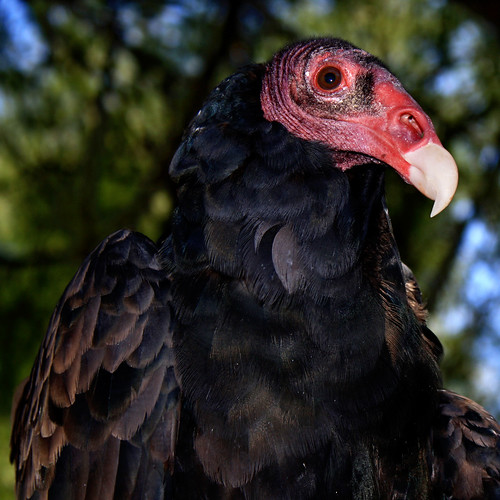 Which isn't even accurate, as far as vulture eyes go. Who ever heard of a vulture with blue eyes? Who looks close enough to know better?
Charles Darwin called our poor turkey vulture "a disgusting bird, with its bald scarlet head formed to wallow in putridity." When reporters are said to "swoop in" on death and misfortune, we know exactly what is meant by the phrase "a bunch of vultures." Even the Bible gives the birds a short shrift, calling them "an abomination."
In comics, arachnids get Spider-Man. Vultures get his rangy beanpole of a foe The Vulture, a nefarious bald villain and remorseless killer who exploits even his allies. In movies, the good-guy-harassing angular ships in Star Wars became known as vulture droids. Even Disney makes its vultures look considerably less cuddly than its ants, depicting them as ungainly, indecisive nerds perching on a rotted, gnarled branch. Businesses that prey on destitute countries, snatching up financial shares at low prices, are known as vulture funds. Dishonest lawyers are called vultures. Virtually nowhere in the western world is calling someone a vulture considered a compliment. And though I've never heard anyone called a turkey vulture, calling one a turkey is hardly considered high praise, and I'm fairly sure no one save turkey-advocate
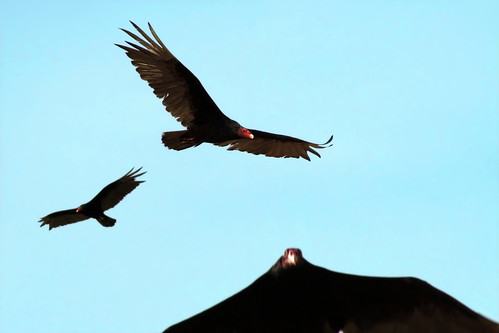 Ben Franklin would consider adding "turkey" to "vulture" a flattering amendment.
It hasn't always been this way. In ancient Egypt, the vulture was associated with the goddess Nekhbet and was the symbol of the upper kingdom. In India, vultures guarded the gates to the underworld. In times past in North America, the vulture was revered; it was the California condor, of the vulture family, that gave shape and form to the legendary Thunderbird. The turkey vulture's Latin name, Cathartes aura means air purifier, or just purifier, and indeed several cultures have seen it as a symbol of purification. Some Native American myths have it saving the world, using its head to push the sun to an optimal distance, becoming bald in the process. Wilbur Wright called turkey vultures "the most perfectly trained gymnasts in the world and are specially well fitted for their work, and it may be that man will never equal them."
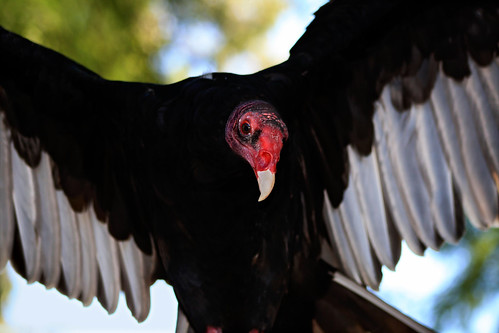
Invariably at the "Bye-Bye Buzzards" and "Welcome Back Buzzards" events someone suggests, in conciliatory tones, that we love vultures for their janitorial services. You know, even though they're so ugly. I guess that's enough for some. I'm glad the birds provide the service, of course. Circle of life, and all that.
But I don't love the birds because they clean our shared environment. It has an uncomfortable feel of loving something only insofar as it's useful to me. Their personality, I think. Maybe that's getting a little closer. They're primal, with a dash of latent cleverness. People might be partial to the hawks and eagles, the emblematic hunters. But turkey vultures wait. They're patient, almost as if respectful of the death upon which they feed.
But that's unfair too, of course. Turkey vultures aren't philosophers. They aren't people.
David's conclusion is to like them "because they're cool" -- just to like them because they are.
I think that's pretty darn close. Also? I really do think she's beautiful.
I've been visiting Ed for the past four years, and watching her kin for ages before that. They ride thermals, roll and twist, seeming to scrape the clouds with their silvery wingtips. They make life out of death, utility out of garbage, and they make it look good. If I feel crappy and I take a drive and watch the vultures, I feel better.
It's pure. It's my catharsis.

Subscribe to:
Posts (Atom)