Saturday, September 5, 2009

Clouded vision

He looked and looked. At nothing.

"What are you looking for?" I asked him.

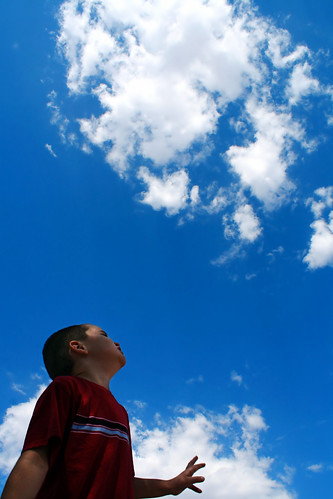
"The rabbit," he said. I rolled my eyes -- unconcerned he might see, because his own were pointed skyward. He always did this. Ask him where his shoes are, or to wipe up the milk, and the mouth goes slack and the eyes roll upward. What the hell is up there?

"Maybe it's behind the bush," I suggested reasonably. A jackrabbit, legs at awkward angles and ears radiating away the afternoon heat, had just loped behind a massive creosote.

"No, Mom," he said. "Up there." (Here "Mom" sounded like "Dumbass" and "Up there" sounded like "Are you high?")

"The rabbit chasing the crocodile," he added as if this clarified the matter. I followed his gaze -- and sure enough, there was a rabbit. To be fair, it had mutated; the ears looked more like antennae and the tail had either elongated or (my son's favored explanation) disappeared behind a particularly long bowel movement. It was indeed chasing a crocodile. The latter appeared to be responding to this encroaching threat by detaching its own tail.

I was late to the game, but we had resumed cloud watching.

It's become a routine. Children, I read recently, become disconsolate each day as the afternoon approaches and passes. The light changes; they re-realize that passage of time occurs and that this day will soon end. They despair.
I don't know about that, but I do know that my son is a freaking jerk if I let him sit on the couch throughout the afternoon. On such days, our conversations go something like this:

Me: Sweetie, why don't you get some homework done? Or demonstrate in some way that you're still among the living?
Him: Mooom! Stop it!
Me: Excuse me?
Him: Stop bossing me a-round!
Me: I don't know why you think you can get away with that attitude, but you can either cut it out or go in the corner and then do your homework anyway.
Him: Mumble mumble whine whine Moooom whine cry mumble sniffle.
Me: Just do your work, and I'll forget it.
Him: No, THANK you! (Flounces to corner, where he sends me Screw you, Mom vibes with his eyeballs.)

He apologizes within sixty seconds and is extra lovey for the rest of the day, but I'd just as soon forgo the experience. We'd sought the solace of the neighborhood park. We were outside for the sheer joy of it, but also to head off any onslaught of grouchiness. It was working.

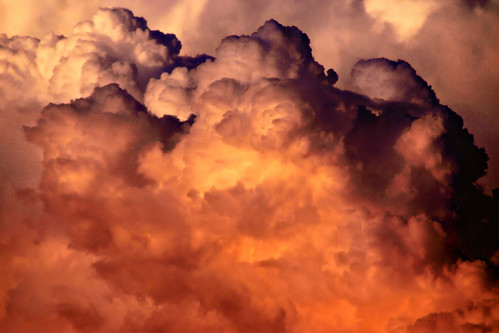
Today, cumulus clouds dominated. ("Hey, Mom!" he'd said with obvious delight, "The weather was wrong! It's not a clear blue day!" Here, I always try to tell my non-Arizonan friends, cloudy equals good weather.) Cumulus are the big puffy clouds that make such good shapes -- the rabbit and crocodile or, earlier, an ice cream cone on a foot.

He stood in the shade created by my body -- nothing like being used as an awning to make one feel nice and petite -- and pointed out a particularly shapely cumulus mediocris (as wide as it is tall) that looked like a fat skull when viewed one way, or flowers another. He preferred the skull. Then he just stood and stared, his index finger half-pointing but forgotten. The gaze and slackened jaw looked more awed than stupid now. An easygoing breeze chased itself in gentle gusts around the trees as birds skimmed the branch tips, and he stared at clouds as solid-looking as mountains, as tall too, but mutable and morphing like the globs in a lava lamp. A knobby, marbly bit of cloud poked from the rest of the mass and was edged with brilliant while light, reminding me of a kid I'd seen once peeking out of the curtains before a school talent show. David absent-mindedly made a "poof" motion with his hand, like you would do to flick water. His fingers stayed open.

Luke Howard, a Quaker and chemist I've been hearing about from David lately, who made up names for the clouds in a specific year I'll totally look up later, was obsessed with clouds. He began at age ten to keep a weather journal. By fifteen, he recorded the weather conditions twice a day, using a thermometer, weather vane, rain gauge, and barometer. I'm not even sure I remember exactly what a barometer does.
David pointed out a stretch of clouds above the cauliflower mass we'd been studying. It looked like a few streaks of cream cheese frosting spread too thin (everyone knows frosting you can see through is way too thin) over the sharp blue sky.

"Cool," I said. "Stratus clouds too!"

"Actually, Mom, I think they're cirrus clouds. Stratus are the lower-down ones," he answered distractedly, extending a thumbs-up before his face as if to frame a picture, but instead pretending to smear it along the wispy clouds.

I looked it up later. He was right, of course.

David probably knows what a barometer does. He wants to be like the "cloud namer guy," he said. I bet Luke Howard looked in the air for his shoes too.

The science club where Howard introduced his paper in the early 1800s -- entrenching stratus, cirrus, and cumulus in meteorology talk and cotton-ball-bedecked construction paper forever after -- had recently featured a "demonstration" of laughing gas, in which, apparently, they watched each other stumble around the stage for the hell of it. Classy sophisticates they were not. But I bet they knew the day would be cloudy if a pine cone's scales were down. They knew what a barometer did. They knew their cirrus from stratus, even before they had names. I bet they finger painted the cirrus clouds.

Howard's achievement was to use a system to give clouds their own names and character, rather than writing them off as gods in the sky and calling it a day. He chose Latin words, modeling his system after Linnaeus. (Fortunately -- or perhaps unfortunately if you're my husband or son -- he chose carefully, and we aren't obliged to point out well formed, billowy labia or a particularly shapely phallus formation.)

David came home with all this information recently, and has wanted to cloud gaze since then. He's done the requisite blue-paper-with-cotton-balls-glued-to-it activity (Of course I can tell one cloud from another, I lied), and his bonus spelling word the other day was cumulonimbus. He's just scratched the surface, but while I turn at once to a book, he remembers to just look at stuff if he wants to learn about it.

So I followed his example. A week later, I can't believe I ever had a hard time telling stratus from cirrus. I can't believe I went first to a book for the answer, instead of the sky.
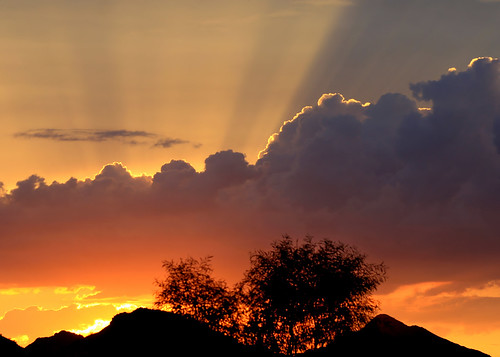
Another thing: Arizona, especially right now, is awesome for clouds. Somehow, I never knew that.

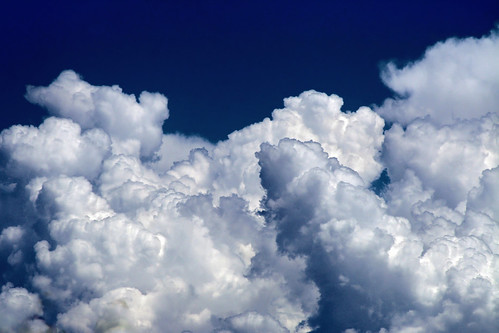
Cumulus are my favorite. Clouds that look solid, not even soft really, fascinate me. The raw cauliflower texture; the bits of harsh white light and spots of navy blue shadow, so that it leaves an after image when I take a picture and look away to blink; the climbing and work I need to do to view them properly over the city's detritus as they droop on the horizon; all draw me as no other formation seems to. The dense, chunky, sharply defined forest of white domes heaps together in some irresistible manner ("cumulus" is Latin for "heaped"). This is the reason I never really got Wordsworth's "I Wandered Lonely as a Cloud," which is otherwise a lovely meditation. I got stuck at "cloud" and pictured one of these. Never mind the daffodils -- what, I wondered, could be lonely about a robust, lively, conglomerated force like this? I'd love to be a droplet in a cumulus. I'd never, ever be lonely. Cumulus are the "cloud-shaped" clouds, and their basic cloud outline was pretty much the staple (and limit) of my artistic endeavors in school.

But David's right; cirrus are pretty awesome too. They're the high-flung, streaky, smeary tendrils and wisps. Cirrus is Latin for "lock of hair," but they seem even more ephemeral than that, though I know they're made of billions to trillions of ice crystals. They seem to spread, drift, separate and rejoin more readily than other cloud types, but don't quote me on that. They feahter and swirl, unreeling and curling tails back on themselves. The ones David and I saw that day looked like wild flowing tresses, fraying and tangling, unfurling and overlapping one another before morphing once again or dissolving entirely.
Stratus clouds are another beast. They're the ones I notice least. During most of the day, even if they're there, you probably won't notice them either. They're soft, diffuse, featureless sheets. However, if you've ever been in a cloud (fog, that is) it was a stratus. And they really come into their own at sunrise or sunset. Their boringness almost makes it more rewarding, since I'm dumb enough to be surprised nearly every time. I'll check the sky and see a palette of totally blah clouds, and prepare to call it a day. Then, just as the sun hits the houses across the street, the stratus clouds act like a sky-sized softbox, bouncing a brilliant diffuse glow of pink or gold or pumpkin orange through our dining room window. If we go outside -- as we nearly always do -- we're rarely disappointed. The flat clouds stay dark throughout about half of their masses, but the bottom half will be a resplendent, textured gradation from purples and maroons all the way through red and orange, to the bottom, where the light escapes in a lemony yellow burst. Nothing catches light quite like a stratus.

And then there are the cloud moments scattered throughout the last week or so, since I began to notice.
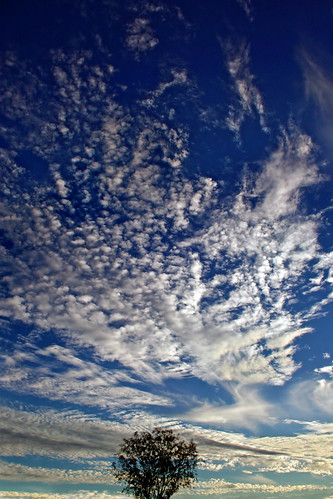
I was driving to the library the other day and saw a turkey vulture flying in the opposite direction, below a massive scaffolding of altocumulus (The big fleecy conglomerations of cloudlets; in this case it looked like perfectly spaced crop rows). The formation, combined with our opposing directions, made the vulture appear to be shooting through the sky even as it lazily tipped and soared.

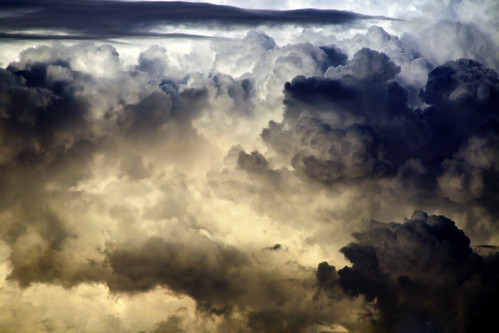
A collection of overstuffed cumulus merged, turned dark brown-gray and developed into a towering cumulonimbus as David and I watched from the swing set in the backyard. We watched the mass (a cumulonimbus can be up to 60,000 feet high, more than twice as tall as the world's highest mountain) as it flickered. Lightning flashed from somewhere deep inside it and thunder rumbled through its thick billows. My hair stung my eyes as a gust whipped it, doves made tiny black arrows against the sky as they flew for cover, and a lizard sat on the slide, doing push-ups and looking apprehensive. All at once the cloud released its potential, big fat drops raising their own mini-clouds in the dust of the parched ground. Within fifteen minutes the rain cleared (I heard later three inches had dropped in those fifteen minutes in some areas). Everything was drowned in a yellow light. I saw a spaghetti-thin tail disappear as the lizard ran for cover.

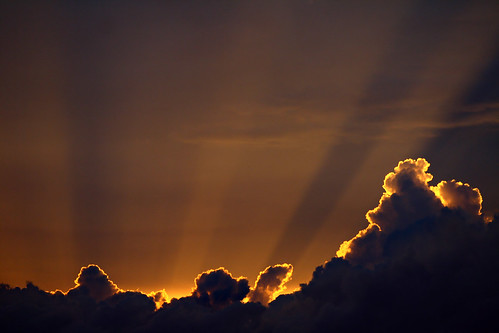
At sunset, David leaned precariously from a ladder, craning to capture the entire thing in his viewfinder as he snapped picture after picture. (I don't know where he picked up that habit.) A long thin cloud, pale and shiny like a scar at first, was suddenly lit from behind. Fine lines of deepest red and blazing yellow singed the horizon as, at last, colors bled together and finally drained from the day. David asked me to write that there were stratus and cumulus. I grab a notepad from the patio that on which I'd written a note to myself earlier that week: We are all symbiotic. (What had I meant by that?) I turned it over, took his notes. He found a feather we think is from a hawk and held it up to the light. The sun highlighted and defined each barb. He held it at arm's length and pretended to brush the clouds into the sky. Just before dipping out of sight, the sun cast rays from the lowermost cloud -- crepuscular rays, which the Maori say are ropes restraining the sun to make the day last longer. The otherwise dull stratus clouds held the sun until the last second, casting warm, soft echoes to us. Like breathable light.

I put my notes away, David grabbed the hawk feather, and we headed in. I prayed for rain the next day, but especially for clouds.


Wednesday, August 26, 2009

Snapshots

More snapshots. His pictures, my words. Well, some of his words too, actually. But there's attribution.

**He stared at the television as an Ambien commercial droned "Risk of suicide may increase," and I wondered what I would say if he asked about suicide. Instead, he said "If I need help sleeping, I try to dream about you. And dolphins."**

**I needed him to be ready to go by 8:30. I asked him at 7:30 to put on his socks and shoes. 7:45, nothing. "David, put your shoes on," I repeated. "Okay," he replied with total sincerity, and continued reading his comic book. 7:55, 8:10, still no progress. "David!" I said, getting heated now. "Socks! Shoes! Now!" "Okaaaay!" he said, disgusted with me for getting heated when this was clearly the first time I'd asked him. I got everything else ready. At 8:30, one sock was on. "DAVID, I WANT YOU TO PUT YOUR SOCK AND SHOES ON RIGHT NOW!" "Mooooom!" he cried, crushed that I was yelling at him for absolutely no reason. We left at 8:37. His shoes were unfastened.**

**He hunched low in the corner of our yard, inching ever closer to our resident black widow. He'd already gotten a shot of the female and male together. He just barely captured a close-up shot of her front legs before she scurried lightning-quick into a crack in the wall. "Spooky," he said, but he was grinning, and he stuck around until she reappeared.**

**He completed a math worksheet in record time, except for the last problem, which asked him to write out how he would use simple subtraction to help him solve the tougher problems. "I wouldn't," he finally wrote. "They're all too easy."**

**When I picked him up from school his face was stained with a tear streak through a thin layer of dirt. I wanted to make it better right away, but no. Something about kids at his table being mean and him trying to help someone; someone else yelling and the substitute teacher being too distracted to notice. We went out to play, even though it was well above a hundred. Much sweat, more dirt, a few piles of sand, a mercilessly unending game of tag and a hummingbird encounter later, I had managed to make it better.**


**While contemplating wildlife viewing he told me, loudly enough for everyone else who was entering school that day to overhear, "I really want to see a beaver in real life. I'd be the luckiest guy in the world, if I could see a beaver up close!"**

**As we walked to the car after school, two vultures leisurely circled above us, their primaries fanned like dainty fingers smoothing the sky. "Those are turkey vultures," he announced to anyone who would listen. One woman stopped and asked him to tell her more, listening carefully, and not condescendingly, as he imparted his knowledge. He strutted the rest of the way to the car.**

Thursday, August 13, 2009

Must be nice to be perfect

My son is always right. Just ask him.

Argument From Existence
1. David exists.
2. To exist is to think.
3. To think is to have opinions.
4. Opinions in general are flawed, but David's, obviously, are not.
5. Therefore, David is right.

Argument From Earliness (a.k.a. Argument from Mom Doesn't Want to Deal With It):
1. It's 5 a.m.
2. Therefore, David is right.

Ontological Argument**
1. The unrelenting rightness of David exists in David's understanding.
2. Being totally and always right is a possible state of affairs, and might exist in reality.
3. If something awesome exists in David's mind and might have existed then it would be way better that way. The best state of affairs would be if he was really always right. (This includes bedtime, pizza, and whether the cat licking him counts as a bath.)
4. Suppose (theoretically) that David is perfect only in his understanding and not in reality.
5. I know, ridiculous. But just suppose.
6. If this were true, then it would be possible for him to be even more perfect than he is.
7. This is obviously absurd, as David is already perfect. The definition of David is perpetual correctness. It's a clear contradiction.
8. Therefore, David is right.

Argument from the Unbearable
1. Whining.
2. Therefore, David is right.

Argument from "But You SAID..."
1. David has thought about it, and he really feels an imperative to: jump off the roof/backtalk/wail inconsolably about the evening's addition problems.
2. David's parents said it was good for him to: try new things/speak his mind/share his feelings.
3. David's attention and recall are too important to be bothered by just anything, so it must crucial if he's managed to recall parental guidance to manipulate his parents make conscientious life decisions.
4. Therefore, David is right.

Teleological Argument
1. Constructions such as a complex intergalactic storyline at the age of three, clear and stunning photographs by the age of five, and sketches of animals apparently constructed entirely from phalluses at every age are obviously too brilliant to have been accomplished by anyone but a genius of the highest degree.
2. David invented the adventures of Debka, and produces stunning photographs and whole populations of penisauruses to this day.
3. Therefore, David is a genius of the highest degree.
4. Therefore, David is right.

Argument From Hastening of Public Humiliation
1. David has no qualms about bellowing the names of body parts in public.
2. He has been asked to save it until later or whisper, if it's absolutely necessary.
3. Of course, if it occurs to David to say, it must be absolutely necessary.
4. He favors a stage whisper that is much louder than normal talking.
5. Therefore, David is right.

Transcendental Argument
1. Morality, knowledge, bathing, entertainment, purchasing desserts, pet ownership, and watching television have no meaning except in reference to David's desires.
2. You might think you led a meaningful existence prior to seven years ago, but you are mistaken.
3. Therefore, David is right.

Argument from Strength in Numbers
1. David.
2. Another David.
3. Destructive power of a bucket-wheel excavator combined with voices of howler monkeys and the attention spans of hamsters.
4. Sleepover sans sleep.
5. Therefore, David is right.

I'm so proud. And scared.

**It has occurred to me that the people able to fully appreciate my attempt at humor here are also going to be able to recognize that I totally butchered concepts like the telelogical and the ontological argument. Go easy. It's just for fun, plus I haven't had any philosophy or logic courses in many years. Besides, I'm right. Even David said so.

Friday, August 7, 2009

Today before school

Girl: So we need to bring in two or three, and they have to be decorated by Friday.
Dad: So, next week.
Girl: No, Friday!
Dad: Sweetie, do you know what today is?

Mom: So I'm going to ask you again. Do you want chicken or spaghetti tonight?
Bratty kid: Chicken.
Mom: Chicken, what?
Kid: Chicken, because you're mad at me and won't get pizza.

Teacher: What now, guys?
Kid 1: He was being mean and...
Kid 2: No, HE was being mean...
Kid1: But he called me a butthead...
Kid 2: Only because he called me a freak.
Kid 1: So I told him not to and he called me a crybaby!
Kid 2: But THEN he put up his tall man finger, and pretended he was stretching it but I know he wasn't!
Kid 1: But you did the same thing! You didn't make it look like a mistake. And I wasn't pretending.
Teacher: Guys, that means something very rude.
Kid 2: I know what it means! Like effer-something.
Kid 1: What's that?
Kid 2: Like kissing on the lips, but worse!
Both kids: Ewww!
(They run off to play.)

Mom 1: Oh, I know. Like really, who cares?
Mom 2: Right. I mean, they just take random stuff and put it on their blog.
Me: (Practicing my whistling.)

Wednesday, August 5, 2009

Of cockchafers and bushtits ... or my husband's sudden interest in nomenclature

How you know your wife is a little off:

(Wife, hunched in chair, thumbs through a stack of reference books and mutters to self): "No, not that. Aw, man. That's all there is. Cock... Cock... Let's see...Oh! Here's cock. Nope. Just 'chafer.' Cockchafer, cockchafer, cockchafer again. Cock-frickin'-chafer."

(Husband, snickering, stares at wife): "Good book?"

(Wife, not seeing anything particularly odd or funny): "What? Why?"

As many of you may know, I geek out for both critters and words. Entomology and etymology, I like to say. (By "like to say" I mean I've actually said it. I am indeed a scintillating conversationalist.) Recently, I've been meshing the two with a growing interest in and some research into the fascinating areas of taxonomy and binomial nomenclature.

Really. "Fascinating" wasn't supposed to be ironic.

My husband remains unconvinced, and is not as taken by the topic. And by "unconvinced" I mean "clearly ignorant of how right I am," and by "not as taken" I mean "bored, and also less interested than he would be in something that might pay the mortgage."

Besides, interest a topic in my husband's universe generally comes in two flavors. The first is in flashiness, explodeyness, behemothosity, dramatic mega-fauna ... if Jerry Bruckheimer, Micheal Bay, or J.J. Abrams wouldn't be interested, neither would he.

The second is innuendo and scatological humor. Happily for family time, he shares this affinity with my son. They could spend hours watching a baboon documentary, not because the primates are so fascinating, but because they have big red butts.

I tire of such diversions after about ten seconds. So naturally, my husband and son can subsist for weeks on absolutely nothing but booby/wiener/fart/balls/poop/sex puns, and the occasional intake of oxygen.

They want to include me, see, but I can be a little highbrow and cerebral. And by "highbrow" I mean "no fun," and by "cerebral" I mean "boring."

All of this to say, the cockchafer conversation was sort of the perfect storm.

Me: Well, I was looking for a certain passage on the cockroach, but all I can find is cockchafer.
Him: Really. Cockchafer.
Me: No, really, see? Apparently it's what we call a June bug. But this guy seems quite taken with the name cockchafer. He uses it an inordinate amount of times, like even if you're going to use that term. Seriously. "The cockchafer has... The cockchafer flies... The cockchafer usually appears... The cockchafer eats..." Hasn't the guy ever heard of pronouns?
Him: Well, maybe he's just a pervert who gets off on that sort of thing. Like that one guy with the clams. Is it the same guy?
Me: Linnaeus? No, I don't think so. And anyway, it's a different, um, anatomical feature than the ones Linnaeus seemed to favor.
Him: Right. He liked clams named after woman parts.
Me: Exactly. I guess the, er, fleshy part of one looked like the fleshy part of the other...
Him: Well, maybe to him.
Me: ...so he named them after things like the vulva, anus, labia, hymen and something about pubes. I'm not sure on the last one. But I think.
Him: Seriously.
Me: And flowers. He really only looked at what they did sexually. Apparently plant sexual reproduction was a new discovery, so a lot of people were pretty taken with it. He named plants by what he thought of their sex lives, pretty much. There's names meaning "promiscuous intercourse," "barren concubines," and "parted legs." And listen to what he wrote: "The flowers' leaves serve as bridal beds which the creator has so gloriously arranged, adorned with such noble bed curtains, and perfumed with so many soft scents that the bridegroom with his bride might there celebrate their nuptials with so much the greater solemnity."
Him: Wow. Just, wow.
Me: Yeah. I guess a lot of people were kind of bothered by that, especially in the 1700s, but he really was a genius.
Him: Yeah. I can see that.
Me: No, really! He made the basic system for classifying things. And we still use a lot of his names today. I know he named the Mammillaria genus, you know, the nipple cacti...
Him: Those ones you searched for at work?
Me: Yeah. I got pictures of something, but it wasn't cacti, needless to say.
Him: And why nipples?
Me: I guess he thought tubercles -- those things that stick out, with the spines -- looked like nipples.
Him: Not like any I've seen.
Me: And we still have his mollusk names. Look! Penicillus vaginiferus. Vaginiferous? It sounds like some kind of weird-ass compliment: "Your vagina looks vaginiferous tonight, m'dear."
Him: Ha; how about vaginificent. Or vagipendous.
Me: Oh, wait, never mind. Lamarck named that one. But Linnaeus named the whole genus Penicillus. And, apparently, penicillus is a rarely used term for penis.
Him: So that name means penis vagina?
Me: I guess. Oh, here's one Linneaus named. Penicillus penis.
Him: So ... penis penis?
Me: I guess maybe he wanted to make up for the gender bias in his other mollusk names.
Him: At least he had a heterosexual plant and clam fetish.
Me: Here's a biography. It says Linnaeus "loved nature deeply..."
Him: Yeah. A little too deeply.
Me: ...and that it was his job to make a "natural classification that would reveal God's order in the universe."
Him: So he thought God was overly fond of vaginas, then? So did Linnaeus name boobies?
Me: No, I don't think so. And anyway, that's not fair; that's just the common name. There are a bunch of animals with unfortunate common names. Boobies, titmouse, great tit, goatsucker, dik-dik, slippery dick... Some animals have pretty funny stories about where they got their names, but I don't know those ones.
Him: You're just making these up now.
Me: No, really. You're going to question me on an intersection of etymology and biology? I told you it's fun stuff. At least all we have out here is the horny toad, if people call it that; the wood pewee and dickcissel if you really want to push it; I think maybe goatsuckers; a booby was sighted in Arizona once I think but not in a while...
Him: Sounds familiar.
Me (ignoring): ...and the cockchafer obviously, and the nipple beehive cactus. Oh, and the bushtit.
Him: Hee. Bush. Tit. And I thought there was a whole group of nipple cacti.
Me: Genus. And maybe they made sure the other common names were less, um, distracting. Scientific names are pretty bad too. Enema pan, that's a beetle; there's some kind of snail called Fukuia something; ooh, and a solpugid, I love those, called Eremobates inyoanus. I love that one. A something fartus and a Fartulum something. And my favorite is Colon rectum. That's a beetle too.
Him: Scientists have a warped sense of humor, I guess.
Me: They do! Look; here's a story about a fungus named Phallus drewesii. Apparently, this guy named Drewes was on an expedition with a friend of his who's a mushroom expert, and he found this two-inch-long, crooked, phallic-shaped mushroom and jokingly named it after his friend.
Him: So the whole name comes from a your-penis-is-smaller joke.
Me: Yep.
Him: Well, just find more stories like this, and I might be more interested in this field.

(Later)
Him: Say it again.
Me: Oh, come on.
Him: No, really. Is it "entomology?" I thought that was insects.
Me: Oh! Etymology. Study of word origins. Entomology is insects. Sorry. I thought you wanted me to say the stupid bug name again.
Him: Hey.
Me: What?
Him: Say it.
Me: Say what?
Him: You know.
Me: [Sigh.] Cockchafer.

Friday, July 31, 2009

Summertime and the living is easy (snapshots)

School's in -- around here, we start early, and his school starts earlier than most -- and I was afraid we'd squandered our vacation time. It flew by, and now it's back to work. Back to reality. Now we'll have even less time together. I was sad.

I was stupid. He thrives in school, as always. I'm almost eking out a routine that will actually produce some stuff. I'm getting stuff done around the house, and when I pick him up, we make sure to treasure our hours together. We're all getting into a routine, and it's far from drudgery. It's comforting.

Continuing another routine (hey, three times is good for me), here are the snapshots. His pictures, my words.

**He set up a notepad on the shelf of our backyard grill and took notes on everything: me ("Mom seems to enjoy taking pictures of the storm"), my husband ("Seems to have trouble telling boys from girls") (not what it sounds like), the cat ("Likes to smoosh his paw against the window and purr"), the birds ("Like to fly crazy in the clouds").**

**He wrote other stuff, but he said the rest is secret. He hunched over the tiny blue notepad, pencil scratching. The sun sank, casting bright platinum and gold strings, tracing his chin and upper lip, each fine hair along his arm, and the pencil in a glowing ribbon.**

**As I tried (in vain) to get work done in the afternoon, I heard "Hey. Hey! What's that spilling all over the coffee table?!" followed by the sound of pounding feet, frantic towel-fetching, and "Sorry! I'll get the carpet too. Sorry!" I drowned it out with the sound of fingers on keyboard.**

**A black cloud of some bird or other (we said doves, but they were so wild, so primal), now rippling along its ranks and now morphing and globbing like a giant amoeba, slowly made its erratic progress across a heavy slate gray sky. The three of us stood watching from our driveway as a fierce wind hurled dust and leaves into our eyes.**

**I dropped him off at school this morning, and instead of lining up he dawdled in a patch of tall grass. "I don't know what he's doing," I said, half-irritably, to no one in particular. "They're looking at spiderwebs in the grass," a neighboring mom told me. "Oh!" I replied. "Well that's fine then!" She looked at me as if I had said it was fine for them to poop in the hallways. My son glanced over, smiled, waved, and raced to line up.**

**After the spill in the living room, I continued to tune out my family as I heard the commencement of a raucous game of living room ball (the object of which appears to be to kick a ball about the living room until the cat is traumatized or something gets broken). My husband kicked the ball, which bounced off my son. "You hit me in the ASS!" he said. "Your what?" "My ass!" He replied, pointing, my husband later told me, to the front of himself. Discussion ensued. Some minutes later: "David! No one has one giant booby!" I snickered, gave it up and joined them.**

**I came in from working in the yard for an hour, dizzy and radiating heat. He ran to hug me. "You smell like the sun," he told me. "Thanks a lot," I said. Are you saying I smell sweaty?" He shook his head. "Nope. Just like the sun. It's beautiful."**

**He whined, groused, and dug in his heels about homework. Even counting to three in a threatening tone didn't work. "Fine," I said. "You can be grouchy alone."**

**Pink sunrise light streamed through his bedroom window. We moved getting-up time back ten minutes, and played with action figures on his bed.**

**Fifteen minutes after the homework confrontation, he crept into the office, walked silently up to me and kissed my cheek. "I'm sorry I was a grouch," he said. All his homework was done.**

**He brought me a curled brown leaf, probably left over from months ago and dislodged during yard clearing. It was wholly unremarkable. "Here," he said. "This one is special." I took it. I still have it.**

Wednesday, July 29, 2009

Harry situations

The world isn't divided into good people and Death Eaters. --Sirius Black to Harry Potter, Harry Potter and the Order of the Phoenix.

Accio brain! --Ron Weasley to giant brain, Harry Potter and the Order of the Phoenix. Also what some folks evidently need to say, provided they ever find theirs again.

[Warning: This post isn't intended to be spoilery, and it segues (very lamely and very briefly) to what this blog is meant to cover, but I'm not trying not to be spoilery. If you haven't read/watched through HP No. 6, be ye warned.]

Recently I've been receiving (or re-receiving, in most cases) a small mountain of correspondence in the form of forwarded e-mails ("FW: Fwd: FW: RE: FW: Re: Ur DESTROYING ur CHILDREN") relating to Harry Potter. It coincides with the theatrical release of Harry Potter and the Half-Blood Prince. But really? I thought we were over this.

Even so, I'd be slightly sympathetic to (though not in agreement with) claims that the movie/book in this case is too dark or morally ambiguous for children under, say, ten to handle. I'm sympathetic enough to these claims to clam up when says so in my presence, instead of pointing out that my seven-year-old son is currently part of the way through Half-Blood Prince, scary stuff, complexities and all. And I'd be in agreement with some claims against the movie, namely the baffling absence of two nearly made-for-the-screen scenes at the end of the book, severe abridgment of dialogue, the removal (again) of the Dursleys, heavy dilution of the titular aspect of the book/film, and other issues.

That's not what these e-mails are about, of course. They're all the same. Though they all go into considerable pseudo-depth, decked out with numbers, bullet points, emoticons, and glittering smiling Jesuses; the upshot of every single one is: Witchraft = evil doings. Harry Potter teaches witchcraft. Kids learn witchcraft, turn evil. (Or, at least, the potential is there for them to learn to mutter incantations and sacrifice Fluffy at the next equinox. Or it might just desensitize them to occultism and they'll blithely hand over Fluffy. And really, who wants to take that chance?)

I take exception right away. Witchcraft isn't real, people. It isn't. It makes me want to restate it with all caps and periods after every word, it's so frustrating. Also, that's not what the Harry Potter series is about, any more than The Jungle Book is about the ability of animals to act in an anthropomorphic manner.

But what if kids don't realize that? What if they turn evil in some misguided quest to be like Harry?

But you know what; I say who cares, because the occult issue distracts from the bigger theme. What if kids don't know? Know what? The difference between real and fake? Between moral and immoral? Good and evil?

Kids are smarter and more nuanced than we acknowledge. If we've done a halfway decent job as parents, they can identify friendship and greed, right and wrong, Mom smiling indulgently and Mom looking like she wants to chuck me out the window of a moving car if I don't stop whining. In fact, if there's anything I really love about the Potter books lesson-wise, it's maintaining an understanding of these things in the face of ambiguity, flaws, and the startling realization that no one (not parents, not authority figures) is perfect. I think that's what makes people uncomfortable, even more than all that evil potion brewing. (For those who haven't read the books, the classes are used far more to show character interaction than magic. Potions, for example, resembles nothing so much as the dictatorship that was my seventh-grade Home Economics class.) It's easier to just tell our kids this is allowed; this is not. This is evil; this is good. Bad people lack love; good parents never make mistakes; teachers and parents and cops never screw up.

It is easier, and I think it's necessary -- almost constantly when they're young, and to some extent throughout childhood. There is a threshold at which parents, teachers, and other authority figures have to have authority just because, a trust from kids that they do know what's best even when kids imagine adults to be far stupider than themselves. But what happens when the teacher is unable to protect you from bullies? What happens when you see Mom and Dad bellowing at each other, slamming doors unnecessarily? If your positive view of them hinged on their supposed perfection, and you've gotten old enough to realize adults are flawed, what then?

The characters in the Potter universe work through these realizations. It is our choices that define who we are, Dumbledore tells Harry. Love and protection and friendship and loyalty are hard won and diligently maintained. Almost all the parents love their children fiercely, even a bad-guy mom, and in all these people, love is to be admired. Bad guys turn out to be good. Good guys turn out to be bad, owing to poor choices. Look more closely, the whole series nearly shouts. Really get to know.

We've used the series to spark a number of conversations, and none of them about wand waving. We do miss people who are gone. Parents aren't perfect, but the good ones never stop trying to be. They'd do anything for their kids, they just don't always do the right things. However, they usually do, and you'd better listen to them if you ever want to receive another Bakugan toy. I think he respects me for being honest. I know it makes him more honest. And it makes him want know more about us. He's taken to keeping notes on us, and it has nothing to do with what we give him or what we won't let him do. He cares about us, as people and as parents.

I wish the e-mail forwarders would look more closely, or at least modify their write-it-off-automatically policy. It's like how David looks at the natural world. Did you know cockroaches spread disease rampantly? That daddy-longlegs have the most potent venom? David knows otherwise, because these things aren't true. I'll keep him away from actual bad influence, as well as disease and deadly venoms, but he has an overwhelming desire to see what's really up with just about everything. To branch out. To discover nuances, freak out about them, make the wrong assumptions, and come around to an understanding about life he didn't previously have. To challenge himself. To question. I'll never keep him from that.